How Many 12x12 Tiles Do I Need to Cover 100 Square Feet? (2027)
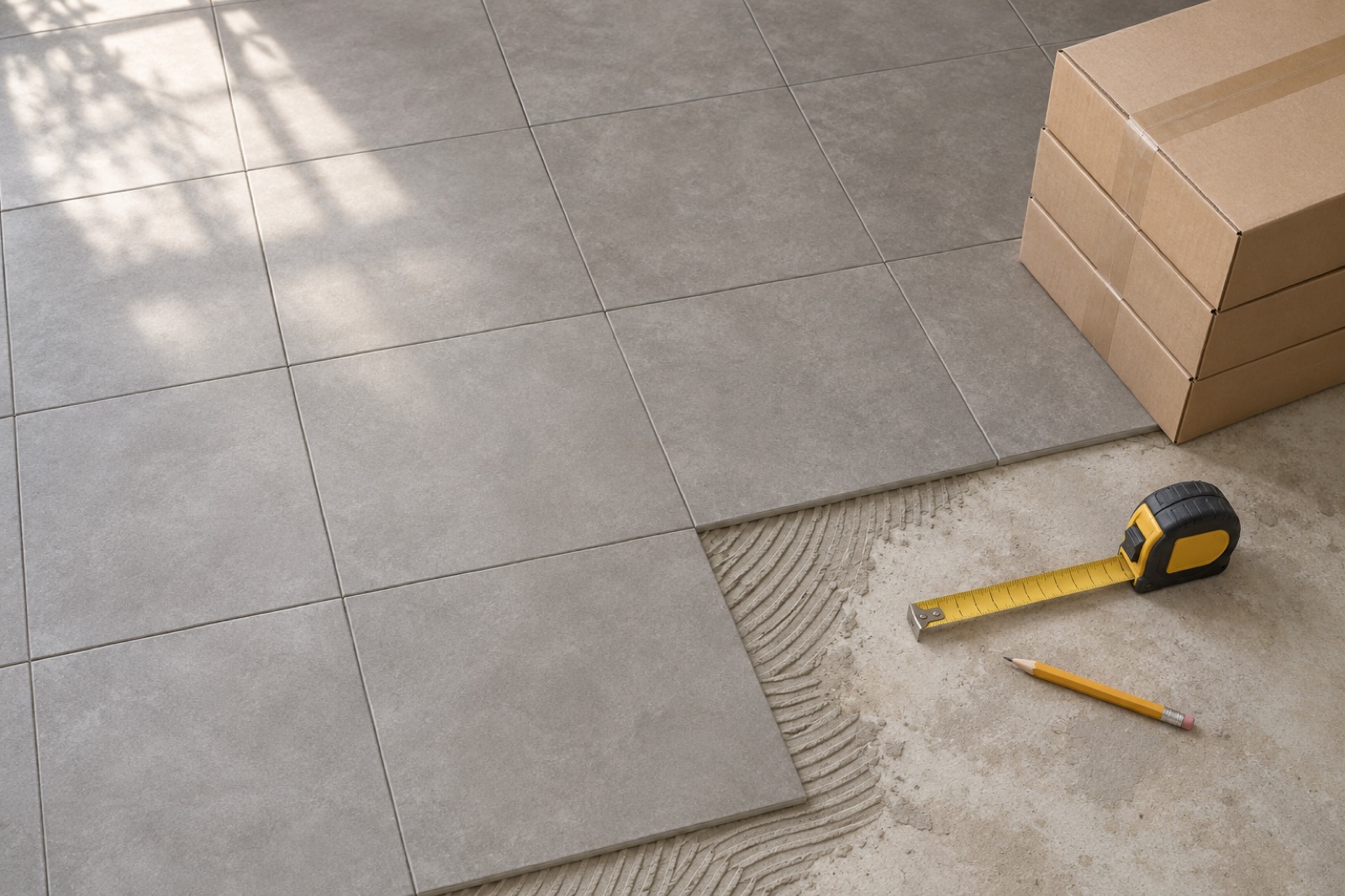
How many 12x12 tiles do you need for 100 square feet?
You need 100 tiles before waste and about 110 tiles with 10% waste. A nominal 12x12 inch tile covers 1 square foot, so the tile count equals the square footage. Most sellers pack tile in cartons, so the real order rounds up to whole cartons (covered in Step 3).
Quick answer box: 100 tiles before waste, about 110 with 10% waste
| Waste allowance | Tiles for 100 sq ft |
|---|---|
| 0% | 100 |
| 5% | 105 |
| 10% | 110 |
| 15% | 115 |
You can't buy 110 loose tiles from most sellers. Tile ships by the carton, and the carton size decides what you actually pay for.
The formula: area ÷ tile area (12 in × 12 in = 1 sq ft)
Tile area in square feet is width in inches × length in inches ÷ 144. For a 12x12 tile that is 144 ÷ 144 = 1 sq ft.
The full calculation has three parts:
- Tiles before waste = room area ÷ tile area. For 100 sq ft: 100 ÷ 1 = 100.
- Tiles with waste = tiles before waste × (1 + waste). For 10%: 100 × 1.10 = 110.
- Cartons = tiles needed (in sq ft) ÷ carton coverage, rounded up.
The rest of this guide walks through each step with real numbers.
Step 1: Measure the room and get to 100 sq ft
Everything downstream depends on the area, so measure first and measure carefully. Use a tape measure, write down each dimension in feet, and round up to the nearest half inch if a wall is not square.
How to measure a rectangular room
Multiply length by width. Both of these rooms are 100 sq ft:
- A 10 × 10 ft room: 10 × 10 = 100 sq ft.
- An 8 × 12.5 ft room: 8 × 12.5 = 100 sq ft.
Measure at the longest points of each wall, since floors are rarely perfectly square. A difference of an inch or two over 10 ft is normal and the extra is absorbed by your waste allowance.
Irregular rooms, alcoves and closets: split into rectangles
Break an L-shape, bump-out or alcove into rectangles, calculate each one, and add them together.
Example: a 12 × 14 ft room with a 2 × 3 ft alcove.
- Main room: 12 × 14 = 168 sq ft
- Alcove: 2 × 3 = 6 sq ft
- Total: 168 + 6 = 174 sq ft
At 10% waste that is 174 × 1.10 = 191.4, so 192 tiles of 1 sq ft each. The method is the same whether the room has two rectangles or six.
Subtract only what you will not tile
Subtract areas that will never receive tile, such as a fixed bathtub or a built-in cabinet that sits on the subfloor. Do not subtract things you might move later, like a freestanding vanity or a washing machine. When in doubt, tile under it or leave it in the count.
Doorways and closet floors usually get tile, so add them rather than subtract them.
Quick note on measuring shower walls
Measure each wall as height × width, subtract any niche or window, then add the walls together.
Example: three walls, 5 × 8 ft, 3 × 8 ft and 3 × 8 ft, with a 1 × 1.5 ft niche.
- Walls: 40 + 24 + 24 = 88 sq ft
- Niche: 1.5 sq ft
- Net: 86.5 sq ft
Shower walls involve more cuts around fixtures and corners, so plan for 15% waste or more. That gives 86.5 × 1.15 = 99.5, or 100 tiles of 1 sq ft.
Step 2: Add waste (and pick the right percentage)
Waste covers cuts, breakage, miscuts and the few tiles that arrive chipped. For 100 sq ft with 10% waste, the math is 100 × 1.10 = 110 tiles.
Treat every percentage here as a rule of thumb. Your installer's layout plan wins, so ask them for a number before you order.
Why 10% is the common default for straight lay
In a straight (grid) layout, tiles line up with the walls and most cuts are simple trims along the edges. A 10% allowance usually covers those cuts plus a few breakages. It is a sensible default for a plain rectangular room with a professional or experienced installer.
When to use 15% or more: diagonal, herringbone, many cuts, small rooms
Use a higher number when the layout creates more offcuts:
| Situation | Typical allowance |
|---|---|
| Straight lay, simple rectangle | About 10% |
| Small rooms, many obstacles, first-time DIY | About 15% |
| Diagonal (45 degree) lay | About 15% |
| Herringbone or complex patterns | 15% to 20% |
| Shower walls with niches and corners | About 15% or more |
Small rooms often need more because cuts at every wall use up a larger share of the tiles. A 100 sq ft room is mid-sized, but a 30 sq ft bathroom with a toilet and vanity can easily need 15%.
Spare tiles for future repairs and dye lot / shade variation
Keep a few spare tiles after the job. If a tile cracks in five years, the same product may be discontinued or come from a different production run with a slightly different shade.
That is why you should buy every carton for the job at the same time and check that they share one lot number. Our dye lot guide explains what to look for on the carton label and what to do when a seller ships mixed lots.
Step 3: Round up to whole cartons
This is the step most calculators skip. You are not buying 110 tiles. You are buying cartons, and each carton holds a fixed number of square feet. Covering 100 sq ft does not mean buying 100 sq ft.
How many sq ft does a box of tile cover?
It depends on the tile and the manufacturer. Common 12x12 cartons run from roughly 10 to 20 sq ft, but you should read the coverage printed on the carton or product page rather than assume. That figure comes from the manufacturer and is the number to trust.
Divide the area you need (with waste) by the carton coverage, then always round up, never down. Rounding down leaves you short, and reordering later risks a different dye lot. For a quick check you can use a flooring box calculator.
Worked example table: 110 sq ft needed
Here is 100 sq ft plus 10% waste, 110 sq ft in total, across common carton sizes:
| Carton coverage | Cartons (rounded up) | Sq ft you receive | Tiles you receive | Extra beyond 110 sq ft |
|---|---|---|---|---|
| 10 sq ft | 11 | 110 | 110 | 0 |
| 11 sq ft | 10 | 110 | 110 | 0 |
| 12 sq ft | 10 | 120 | 120 | 10 |
| 15 sq ft | 8 | 120 | 120 | 10 |
| 20 sq ft | 6 | 120 | 120 | 10 |
The calculation for the 15 sq ft carton: 110 ÷ 15 = 7.33, which rounds up to 8 cartons. Eight cartons hold 120 tiles.
What you end up with: extra tiles and what that costs
Rounding up means extra tiles. In the table above, three of the five carton sizes leave you 10 tiles beyond your 10% waste allowance. Those extras are not wasted: they act as your spare tiles for repairs.
The cost of the extras is simple. Take the leftover sq ft and multiply by the price per sq ft. If a 15 sq ft carton costs $45 ($3.00 per sq ft), the 10 extra sq ft cost about $30. Price your spares into the budget before you buy.
Nominal vs actual tile size, and grout
A tile sold as "12x12" is a nominal size. The actual tile often measures slightly less, and that changes the count on a large floor.
Why a "12x12" tile may measure 11.75 or 11.81 in
Manufacturers round names to convenient numbers. Some 12x12 tiles measure 11.75 in. Tiles made in millimetres, such as a 300 mm tile, measure about 11.81 in.
Here is the effect on 100 sq ft, before waste:
| Actual tile size | Area per tile | Tiles for 100 sq ft |
|---|---|---|
| 12 × 12 in | 1.000 sq ft | 100 |
| 11.81 × 11.81 in (300 mm) | 0.969 sq ft | 104 (103.2 rounded up) |
| 11.75 × 11.75 in | 0.959 sq ft | 105 (104.3 rounded up) |
For the 11.75 in tile: 11.75 × 11.75 = 138.06 sq in, and 138.06 ÷ 144 = 0.959 sq ft. Then 100 ÷ 0.959 = 104.3, so 105 tiles.
Does grout change the count? Small effect on 100 sq ft, bigger on small tiles
Grout joints add space between tiles, so each tile effectively covers its own area plus half a joint on every side. An 11.75 in tile with a 1/4 in joint takes up a 12 in grid square, which is a full square foot. That is why a 100 sq ft layout can still land close to 100 tiles even when the tile itself is a little smaller.
On large tiles the effect is small. On mosaics and small tiles, joints take up a bigger share of the floor, so the count shifts more. Joint width is set by the installer, the tile type (rectified tiles often allow narrow joints) and the spec sheet. Use the manufacturer's carton coverage as your anchor and talk to your installer about the joint.
Same math for other sizes: 600×600 mm and 1200×600 mm in sq ft
Convert square metres to square feet by multiplying by 10.764.
- 600 × 600 mm = 0.36 m² = 3.875 sq ft. For 100 sq ft: 100 ÷ 3.875 = 25.8, so 26 tiles before waste, or 29 tiles at 10% (110 ÷ 3.875 = 28.4).
- 1200 × 600 mm = 0.72 m² = 7.75 sq ft. For 100 sq ft: 100 ÷ 7.75 = 12.9, so 13 tiles before waste, or 15 tiles at 10% (110 ÷ 7.75 = 14.2).
Large-format tiles are also sold by the carton, often with only two to four pieces per box, so carton rounding can add more extra area than it does with 12x12.
Quick answers for other common sizes of room
10x10 room
A 10 × 10 ft room is 100 sq ft. That is 100 tiles of 12x12, or 110 with 10% waste.
12x12 room (144 sq ft)
Be careful with the wording. "A 12x12 room" is 12 ft by 12 ft, which is 144 sq ft. It is not 12 tiles by 12 tiles of 12x12 inch tile in the sense of one tile. You need 144 tiles of 12x12 inch tile before waste, and 144 × 1.10 = 158.4, so 159 tiles at 10%.
144 sq ft total
Any 144 sq ft area, whatever its shape, uses the same numbers: 144 tiles before waste and 159 at 10%. As cartons, 15 sq ft boxes give 158.4 ÷ 15 = 10.56, so 11 cartons (165 sq ft).
Formula cheat sheet
- Room area (sq ft) = length (ft) × width (ft)
- Tile area (sq ft) = width (in) × length (in) ÷ 144
- Tiles needed = round up of area × (1 + waste) ÷ tile area
- Cartons needed = round up of (area × (1 + waste)) ÷ carton coverage
For Shopify tile merchants: sell cartons, not guesses
If you sell tile online, the shopper's question is the same one this article answers, and a wrong answer lands on your support desk. The aim is to turn a room size into a whole number of cartons at checkout.
Why per-variant workarounds and quote forms fail
A common workaround is a "per sq ft" variant. The problem is that the Shopify quantity then means one thing to the shopper (square feet) and another to your warehouse (cartons). A shopper types 100 into a product sold in 20 sq ft cartons and expects 100 sq ft. Nothing in the cart says otherwise.
Quote forms avoid that, but they delay checkout and push the math onto your team. Every manual correction is a chance for a mismatch, and wrong quantities turn into returns and tickets. We cover the trade-offs in how to sell by square foot on Shopify.
What the shopper should see: room size, waste, cartons, coverage, estimated total
A good flow shows the shopper:
- Room size (length and width, or total area)
- The waste percentage applied
- The number of cartons, rounded up
- The coverage those cartons give, such as 120 sq ft
- An estimated total
For a 10 × 10 ft room, 10% waste and a 15 sq ft carton, the shopper sees 8 cartons covering 120 sq ft.
How Shoperize Price Calculator handles it
Shoperize Price Calculator lets the shopper enter area or dimensions, and the merchant sets unit conversion, waste, package coverage, rounding and limits. Measurements stay in the cart, and coverage updates if the shopper changes the quantity. Charges follow your Shopify catalog prices, so the cart total stays tied to the product price you set.
The Free plan supports one published area calculator on up to three products. Other capabilities depend on the plan. For the full flow, see our Shopify tile calculator page and the Shopify square footage calculator guide for cart behavior and setup details.
If you sell tile by the carton, you can install Shoperize Price Calculator from the Shopify App Store and see the details at calculator.shoperize.com. Setup help is available at help.shoperize.com.
Frequently Asked Questions
How do I measure my room for tiles?
Measure the length and width of each rectangular section in feet and multiply them to get square feet. Split L-shapes and alcoves into rectangles and add them together. Subtract only areas you will not tile, such as a fixed tub, then add waste.
How many sq ft does a box of tile cover?
It varies by tile and manufacturer. Many 12x12 cartons cover roughly 10 to 20 sq ft, but the printed coverage on the carton or product page is the number to use. Divide your needed area by that figure and round up to whole cartons.
How to calculate flooring?
Multiply length by width to get the area, then multiply by 1 plus your waste percentage (for example 1.10 for 10%). Divide by the coverage of one carton and round up. For 100 sq ft with 10% waste and 15 sq ft cartons, that is 110 ÷ 15 = 7.33, so 8 cartons.
How to measure a shower for tile?
Measure each wall as height times width, subtract any niche or window, and add the walls together. Plan for around 15% waste or more because of the extra cuts around corners and fixtures. Check with your installer for the layout.
How many 12x12 tiles do I need for 144 square feet?
You need 144 tiles before waste, since each nominal 12x12 tile covers 1 sq ft. With 10% waste that is 158.4, so order 159 tiles, then round up to whole cartons based on the coverage printed on the box.