Vinyl Flooring Calculator Square Feet: Boxes & Waste (2027)
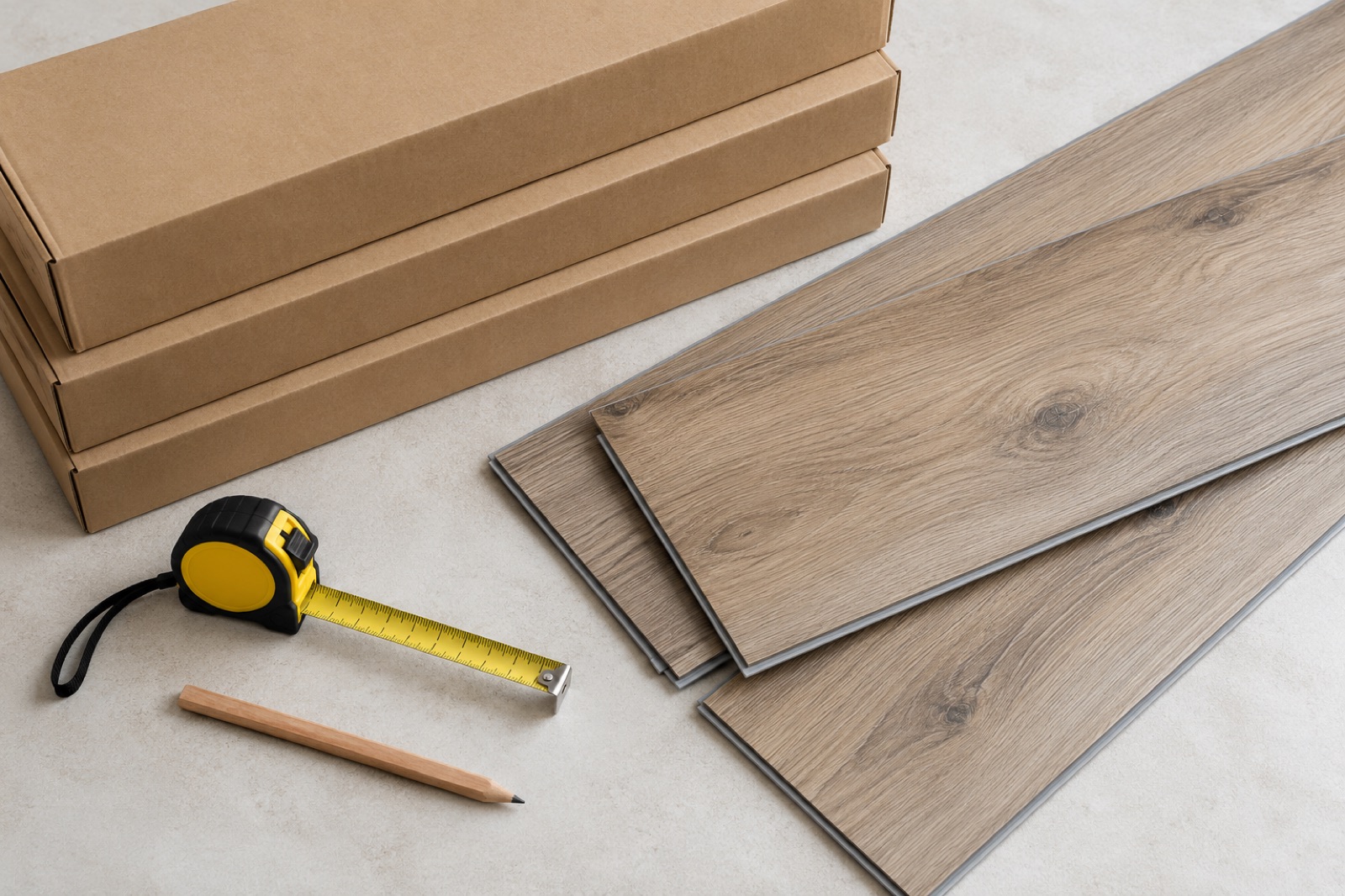
How much vinyl flooring do I need? The short answer
Multiply room length by width to get square feet, add a waste percentage, divide by the square feet in one box, and round up to whole boxes. For a 12 x 12 ft room, that is 144 sq ft, plus 10% waste for 158.4 sq ft. With 20 sq ft boxes, 158.4 / 20 = 7.92, so you need 8 boxes (160 sq ft).
Formula: length x width = sq ft, x (1 + waste %), divide by sq ft per box, round UP
- Area: length (ft) x width (ft) = square feet.
- Add waste: area x (1 + waste %). For 10%, multiply by 1.10.
- Divide: total sq ft / coverage per box. Use the coverage printed on the carton, not the plank dimensions.
- Round up: 7.92 boxes is 8 boxes. 7.01 boxes is also 8 boxes. Never round to the nearest whole number, because a short order leaves a gap in the last row.
The same math works for laminate, engineered wood and other boxed flooring. Only the waste percentage and the carton coverage change.
Vinyl flooring calculator: quick reference table
This table covers three common sizes at 7%, 10% and 15% waste, with carton coverage of 20, 23.64 and 24 sq ft. The 23.64 column is there on purpose: many cartons do not cover a tidy number, and the rounding can change in surprising ways. You can check your own numbers with our flooring box calculator.
| Room | Base sq ft | Waste | Sq ft needed | Boxes at 20 | Boxes at 23.64 | Boxes at 24 |
|---|---|---|---|---|---|---|
| 12 x 12 room | 144 | 7% | 154.08 | 8 | 7 | 7 |
| 12 x 12 room | 144 | 10% | 158.4 | 8 | 7 | 7 |
| 12 x 12 room | 144 | 15% | 165.6 | 9 | 8 | 7 |
| 1,000 sq ft | 1,000 | 7% | 1,070 | 54 | 46 | 45 |
| 1,000 sq ft | 1,000 | 10% | 1,100 | 55 | 47 | 46 |
| 1,000 sq ft | 1,000 | 15% | 1,150 | 58 | 49 | 48 |
| 1,200 sq ft | 1,200 | 7% | 1,284 | 65 | 55 | 54 |
| 1,200 sq ft | 1,200 | 10% | 1,320 | 66 | 56 | 55 |
| 1,200 sq ft | 1,200 | 15% | 1,380 | 69 | 59 | 58 |
Look at the 12 x 12 room at 15% waste with 23.64 sq ft cartons. It needs 165.6 sq ft, and 7 boxes cover 165.48 sq ft. That is 0.12 sq ft short, so the answer is 8 boxes, not 7.
12x12 room
144 sq ft. At 10% waste you need 158.4 sq ft, which is 8 boxes of 20 sq ft or 7 boxes of 23.64 sq ft.
1,000 sq ft
At 10% waste, 1,000 sq ft becomes 1,100 sq ft. That is 55 boxes of 20 sq ft, or 47 boxes of 23.64 sq ft.
1,200 sq ft house
At 10% waste, 1,200 sq ft becomes 1,320 sq ft, which is 66 boxes of 20 sq ft. One caution: a 1,200 sq ft house rarely has 1,200 sq ft of vinyl floor. Carpeted bedrooms, tiled baths, closets and walls all change the number. Measure the rooms you are covering, not the house footprint.
Pick the right waste percentage for vinyl plank
There is no single correct waste number. These are typical ranges, and your flooring manufacturer's installation guide should override them.
Straight lay: about 7-10%
Planks run parallel to the longest wall in a simple rectangle. Cuts at the ends of rows can often start the next row, so less is thrown away. Many installers plan around 10% to leave room for bad cuts and defects.
Random stagger, L-shaped rooms: 10-12%
Random stagger needs a minimum offset between end joints, so some cut-offs are too short to reuse. L-shapes, bump-outs and doorways add more cuts. Plan on the higher end for rooms with many corners.
Diagonal or herringbone: 12-20%
Diagonal layouts waste material at every wall because each plank is cut at an angle. Herringbone adds even more cutting. Commonly quoted figures run up to about 20%.
Plank length vs room length
Waste depends on how the room length divides into plank length. In a 12 ft room with 48 in planks, rows divide cleanly into three planks. In a 13 ft room, each row ends with a 1 ft piece, which you may or may not be able to reuse under the stagger rule. If you sell many plank lengths, say so on the product page rather than assuming one waste number fits all.
Worked examples with carton rounding
All examples use 20 sq ft cartons and 10% waste unless stated.
Bedroom 10x12 with 10% waste
- Area: 10 x 12 = 120 sq ft
- With waste: 120 x 1.10 = 132 sq ft
- Boxes: 132 / 20 = 6.6, round up to 7 boxes (140 sq ft)
Open living area with a closet and an L-shape (subtract and add sections)
Split irregular rooms into rectangles, add the pieces, then subtract anything permanent that the floor does not run under.
- Main area: 16 x 14 = 224 sq ft
- L-shaped alcove: 6 x 8 = 48 sq ft (add)
- Closet where the floor continues: 3 x 4 = 12 sq ft (add)
- Fireplace hearth: 2 x 5 = 10 sq ft (subtract)
- Total: 224 + 48 + 12 - 10 = 274 sq ft
Cabinets and islands are a judgment call. Kitchen cabinets installed before the floor usually are not covered, but an island on a floating floor may be, depending on the manufacturer's guidance. An L-shape has more cuts, so use the 10-12% range. At 10%: 274 x 1.10 = 301.4 sq ft, and 301.4 / 20 = 15.07, so 16 boxes. At 12%: 274 x 1.12 = 306.88 sq ft, which is 15.34 boxes, also 16 boxes.
Whole-floor job: add rooms first, then waste once, then round once
Take four rooms: the 120 sq ft bedroom, a second bedroom of 11 x 12 = 132 sq ft, a 4 x 15 = 60 sq ft hallway, and the 274 sq ft living area.
Round once at the end:
- Total area: 120 + 132 + 60 + 274 = 586 sq ft
- With 10% waste: 586 x 1.10 = 644.6 sq ft
- Boxes: 644.6 / 20 = 32.23, round up to 33 boxes (660 sq ft)
Round per room:
- Bedroom 1: 132 / 20 = 6.6, so 7 boxes
- Bedroom 2: 145.2 / 20 = 7.26, so 8 boxes
- Hallway: 66 / 20 = 3.3, so 4 boxes
- Living area: 301.4 / 20 = 15.07, so 16 boxes
- Total: 35 boxes
Why rounding per room can overbuy
Rounding each room adds up to four partial-box surpluses, where rounding once adds only one. Here that is two extra boxes, or 40 sq ft. Leftover pieces from one room are routinely used in the next, so the whole-job method is usually enough. The exception is when rooms are installed at different times, or the installer says offcuts cannot cross room boundaries. In that case, follow the installer.
Many buyers also keep a box or two beyond the calculation for future repairs. If you sell that way, make the spare a conscious choice rather than a rounding accident, and see how to track dye lots and reorder matching stock, because a reorder months later may not match the original production lot.
Sheet vinyl is different: roll width and linear feet
Sheet vinyl comes on a roll, so you buy a length of a fixed width, not boxes. The quantity is linear feet, and the area you pay for is usually larger than the room.
12 ft and 6 ft roll widths
Common roll widths are 12 ft and 6 ft, though your supplier's widths may differ. A 12 ft roll covers most rooms with no seam, but you pay for the full width along the length you cut.
Example: 11x14 room from a 12 ft roll
- Room area: 11 x 14 = 154 sq ft
- Orientation: run the roll along the 14 ft side. The 11 ft width fits inside the 12 ft roll, so there is no seam.
- Linear feet purchased: 14 ft
- Square feet purchased: 14 x 12 = 168 sq ft
- Difference: 14 sq ft more than the room area
Turning the roll the other way would need 14 ft of width, which a 12 ft roll cannot give you without a seam. With a 6 ft roll, the 11 ft width needs two 14 ft runs, or 28 linear ft (168 sq ft), plus a seam down the middle.
Seams and pattern repeat
Patterned sheet vinyl needs extra length so the pattern lines up across seams. The extra depends on the repeat size, so use the manufacturer's stated repeat rather than a generic percentage. A plain roll with no repeat needs less.
For Shopify, this is a sell-by-length scenario, not a box one. Shoppers enter room width and length, and the store works out the linear feet to buy. Read more on selling by length with minimums and increments.
Why quote forms and one-variant-per-size setups fail on Shopify
A shopper can run the formula above, but they often do not. On a plain product page, the options are usually a quantity box and an add-to-cart button, and the problems follow from that.
Shopper guesses boxes and orders short
Someone measures a room, divides by the box size in their head and forgets waste, or forgets to round up. They order 7 boxes where 8 are needed. The install stops with one row left, and the store gets a support ticket plus a second shipment, possibly from a different production lot.
Variants per room size explode and still miss waste
Creating variants like "Covers 150 sq ft" or "Covers 200 sq ft" seems practical until you count the combinations. Every room size needs its own variant, and every variant must still assume a single waste percentage. A herringbone buyer and a straight-lay buyer with the same room get the same answer, and one of them is wrong.
Manual fixes, split shipments, returns on opened boxes
Quote forms move the problem to your inbox. Someone has to read the room size, do the math and reply, which slows orders and invites typos. When an order is wrong, you handle split shipments or returns. Opened flooring boxes are commonly non-returnable, though you should check your own policy, so errors often become either a loss or an unhappy customer.
The fix is to run the math where the shopper is, round to whole cartons, and keep the measurement attached to the order.
Add a vinyl flooring calculator to your Shopify store
Shoperize Price Calculator is a Shopify flooring calculator that turns shopper dimensions into purchasable box quantities. It is live on the Shopify App Store. For step-by-step configuration, see our square footage calculator setup for boxes, waste and cart.
What to set: unit conversion, coverage per box, waste %, rounding, min/max limits
- Unit conversion: accept feet, inches or meters, and convert to the unit your coverage uses.
- Coverage per box: the sq ft on the carton, such as 20 or 23.64.
- Waste %: a default such as 10%, chosen for your typical layout.
- Rounding: always round up to whole boxes.
- Limits: minimum and maximum quantities, so a typo does not become a 400-box order.
- Product assignments: attach the rule to the vinyl products it applies to.
Walk through the 12x14 ft room with 10% waste and 20 sq ft boxes
- Shopper enters 12 ft x 14 ft. Area: 168 sq ft.
- Waste at 10%: 168 x 1.10 = 184.8 sq ft.
- Boxes: 184.8 / 20 = 9.24, rounded up to 10 boxes.
- Coverage purchased: 10 x 20 = 200 sq ft.
Measurements stay in the cart; coverage updates when quantity changes
The room dimensions travel with the cart item. If the shopper later changes the quantity, the displayed coverage updates with it, so it never shows 200 sq ft for an order of 9 boxes. Check this behavior in any tool you use, because it is easy to miss.
Price still comes from the Shopify catalog price per box: price x quantity
The charge is the catalog price of the product or variant multiplied by quantity. If a box is $60 in your catalog, 10 boxes is $600. The calculator decides the quantity and does not replace the price Shopify charges.
Plan notes
The Free plan supports one published area calculator on up to three products. Rules can be created manually, from templates, or as an editable AI draft (plan limits apply), so you can start from a draft and review it before publishing.
Set up vinyl products so the math is right
The calculator is only as accurate as the coverage figure you give it.
Store coverage per carton accurately (supplier data)
Use the supplier's stated sq ft per carton, down to the decimal. Rounding 23.64 to 24 shifts the answer on larger jobs: for 1,100 sq ft needed, that is 46 boxes at 24 but 47 at 23.64. Different colors in the same line can have different carton sizes too, so check each one.
Keep carton coverage in variant metafields; Variant CSV can update them from a supplier file
If you have many SKUs, store coverage in a variant metafield so there is one source of truth. Shopify's native metafield editing is fine for a few products. When a supplier sends a spreadsheet with hundreds of rows, Shoperize Variant CSV can help by importing supplier CSVs into variant metafields. It matches exact SKUs, validates values, and shows a before/after review you must approve before anything is applied. It does not create products or edit prices or inventory.
Check trims, underlayment and transitions are separate products
Trim, transitions, stair nosing and underlayment are not covered by the floor calculation. Sell them as separate products, with their own quantities by piece or linear foot. Mention them on the vinyl page so buyers do not discover the gap at install time.
Vinyl calculator checklist before you publish
Run through our 7-point flooring calculator test checklist before going live. At minimum:
- Test 12 x 12: 144 sq ft at 10% waste with 20 sq ft boxes should show 8 boxes.
- Test an odd room size: try 11.5 x 13.25 and check the result by hand.
- Test the minimum order: enter a tiny room and confirm the minimum applies.
- Confirm rounding goes up, not nearest: 9.24 boxes must show 10, not 9.
- Confirm cart quantity edits update coverage: change quantity in the cart and check that coverage follows.
- Confirm the price: quantity x catalog price should equal the cart subtotal.
- Test on mobile: shoppers measure rooms with their phones in hand.
If you sell boxed vinyl by area, you can install Shoperize Price Calculator from the Shopify App Store (details at calculator.shoperize.com). Setup help is at help.shoperize.com.
Frequently Asked Questions
How do I calculate how much vinyl flooring I need?
Multiply room length by width to get square feet, then multiply by 1 plus your waste percentage (1.10 for 10%). Divide by the square feet per box and round up to a whole box. For a 12 x 12 room, 144 x 1.10 = 158.4 sq ft, which is 8 boxes of 20 sq ft.
How many boxes of vinyl flooring for 1,000 sq ft?
With 10% waste you need 1,100 sq ft, which is 55 boxes of 20 sq ft or 47 boxes of 23.64 sq ft. At 7% waste it is 54 and 46 boxes, and at 15% it is 58 and 49. Always use the coverage printed on your carton.
How much vinyl flooring for a 12x12 room?
A 12 x 12 room is 144 sq ft. Adding 10% waste gives 158.4 sq ft, so buy 8 boxes if each covers 20 sq ft, or 7 boxes if each covers 23.64 sq ft. Diagonal layouts need more waste.
How much for a 1,200 sq ft house?
If you are flooring the full 1,200 sq ft with 10% waste, that is 1,320 sq ft, or 66 boxes of 20 sq ft. Most houses have less than 1,200 sq ft of vinyl floor, because carpeted or tiled rooms and walls reduce it. Measure the rooms you are covering instead of using the house size.
Laminate vs vinyl: does the calculation change?
No. Area, waste, coverage per box and rounding up all work the same for laminate, vinyl plank and engineered wood. The waste percentage and carton coverage change by product and layout, so use the manufacturer's numbers. Sheet vinyl is the exception, because it is bought by roll width and length.