How Many Boxes of Flooring Do I Need for a 12x12 Room?
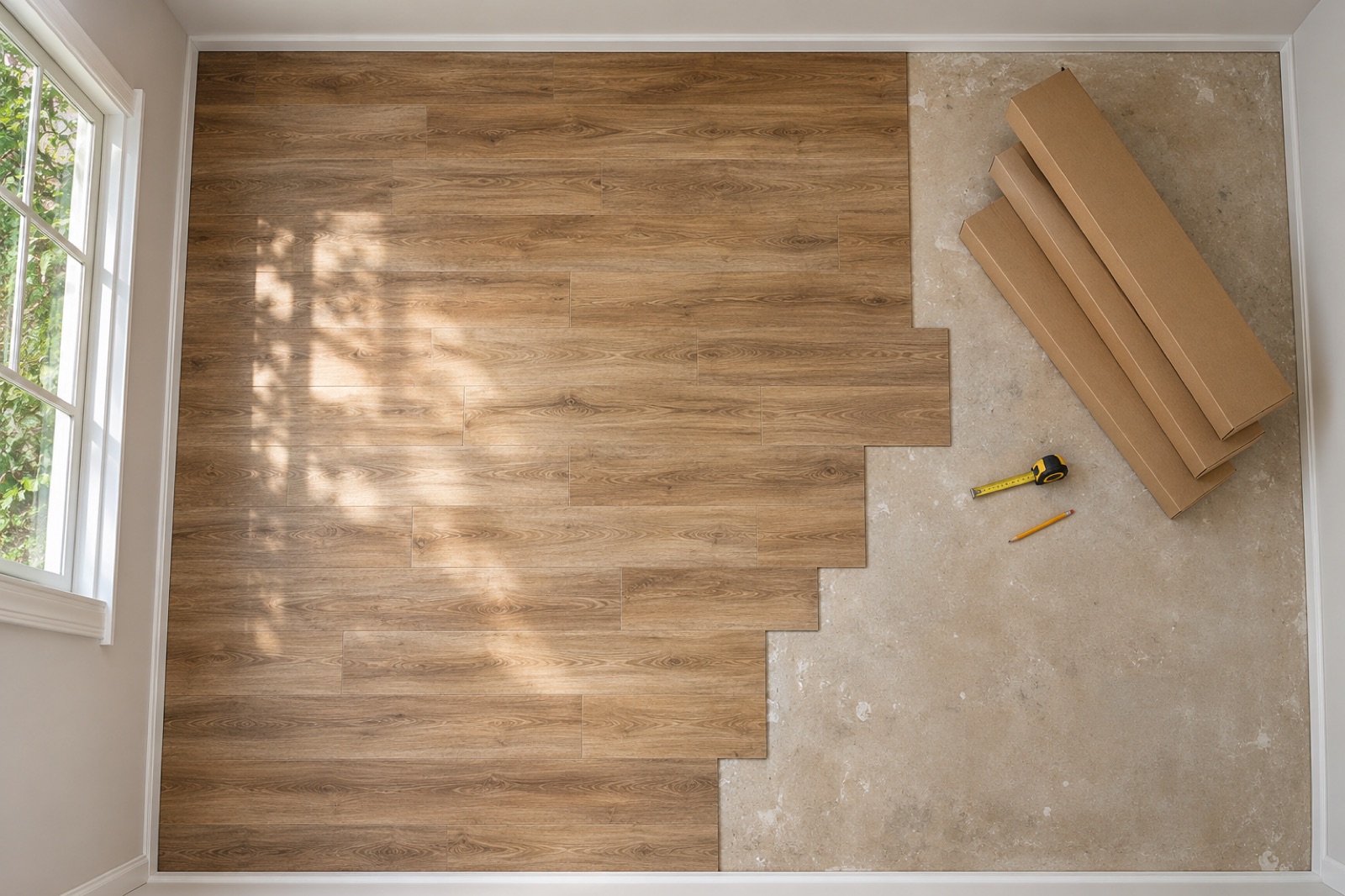
How many boxes of flooring for a 12x12 room? (short answer)
A 12x12 room is 144 sq ft. Add 10% for waste (158.4 sq ft), divide by the coverage on the box, and round up. With 20 sq ft boxes that is 7.92, so you order 8 boxes. The coverage printed on your product's carton overrides the 20 sq ft assumption, and your layout may need more or less than 10% waste.
You can try your own numbers in our flooring box calculator.
The quotable math
- Area: 12 ft x 12 ft = 144 sq ft
- With 10% waste: 144 x 1.10 = 158.4 sq ft
- Boxes at 20 sq ft each: 158.4 / 20 = 7.92
- Order: 8 boxes (160 sq ft)
Waste percentage vs box count (20 sq ft boxes)
| Waste | Sq ft needed | Exact boxes | Order |
|---|---|---|---|
| 0% (raw area) | 144.0 | 7.20 | 8 |
| 5% | 151.2 | 7.56 | 8 |
| 10% | 158.4 | 7.92 | 8 |
| 15% | 165.6 | 8.28 | 9 |
Notice that 0%, 5% and 10% all land on 8 boxes, while 15% tips you to 9. Box size decides where those tipping points fall, which is why the same room can need a different count with a different product.
The formula in four steps
The formula is: area x (1 + waste%) / sq ft per box = boxes, always rounded up.
Step 1: Measure length and width
Measure wall to wall at the longest and widest points, in feet. Include a closet or alcove only if the flooring will run into it. Skip areas that stay uncovered, such as a bathtub footprint or a fixed cabinet run you will not install under.
If a measurement has inches, convert it: 12 ft 6 in is 12.5 ft (6 / 12), not 12.6.
Step 2: Multiply for area
Length x width. For our room, 12 x 12 = 144 sq ft. For an L-shaped room, split it into rectangles and add them. A 12x12 room plus a 4 x 6 ft alcove is 144 + 24 = 168 sq ft.
For several rooms, add all the areas first, then apply waste once to the total. Two rooms of 144 and 48 sq ft make 192 sq ft, and 192 x 1.10 = 211.2 sq ft. At 20 sq ft per box that is 10.56, so 11 boxes.
Step 3: Add waste
Multiply the area by 1 plus your waste percentage. Waste covers cuts at walls, awkward end pieces, damaged planks and mistakes. Layout drives the percentage, and the next sections cover typical ranges.
Step 4: Divide by coverage per box and round up
Divide by the sq ft per box listed on the carton or product page. Then round up to a whole box, every time. Boxes are sold sealed, so 7.92 boxes is not something you can buy.
The trap is rounding by feel. 7.92 to 8 is obvious. But 7.2 is where people round down to 7, and that leaves the floor short before any waste is counted.
Metric version: 12 ft is about 3.66 m, so the room is roughly 3.66 x 3.66 = 13.4 m2. With 10% waste that is about 14.7 m2. Divided by a 2.2 m2 pack, that is 6.69, so 7 packs. The steps are identical, only the units change.
Worked example: 12x12 room at different box sizes
The 20 sq ft box is a convenient round number, but real cartons vary. Here is the same 158.4 sq ft requirement (144 sq ft with 10% waste) at three coverage sizes.
| Coverage per box | Exact boxes | Boxes ordered | Sq ft purchased | Extra beyond 158.4 |
|---|---|---|---|---|
| 20 sq ft | 7.92 | 8 | 160.0 | 1.6 |
| 23.6 sq ft | 6.71 | 7 | 165.2 | 6.8 |
| 15.5 sq ft | 10.22 | 11 | 170.5 | 12.1 |
20 sq ft box: 8 boxes
8 x 20 = 160 sq ft. That is only 1.6 sq ft above the 158.4 you planned for.
23.6 sq ft box: 7 boxes
Plank cartons often list odd coverage figures like this one. 158.4 / 23.6 = 6.71, so 7 boxes, which is 165.2 sq ft. Check the number on your own product, because it varies by brand and line.
15.5 sq ft box: 11 boxes
158.4 / 15.5 = 10.22. Even that small 0.22 forces an eleventh box, giving 170.5 sq ft.
Waste is not the same as rounding leftover
You planned 10% waste, but what you actually end up with depends on box size. Against the raw 144 sq ft, the 20 sq ft order has 16 sq ft extra (about 11.1%). The 23.6 sq ft order has 21.2 sq ft extra (about 14.7%). The 15.5 sq ft order has 26.5 sq ft extra (about 18.4%).
That leftover is a result of selling whole boxes. It is useful as repair stock, but it is not a sign you added too much waste.
How much waste should you add? Vinyl plank, laminate and tile
Typical ranges are a guide, not a rule. The manufacturer's installation guide or your installer sets the number for your product and layout.
- Straight lay in a simple room: often about 5-10%
- Diagonal, herringbone, or a room with many doorways and angles: often 10-15% or more
- Large-format tile or patterned layouts: often at the higher end, since cuts and matching use more material
Vinyl plank, laminate and tile compared
Vinyl plank and laminate both come in cartons with a stated sq ft coverage, so the box math above applies directly. Laminate and click-lock vinyl planks are cut at the end of each row, and offcuts can often start the next row, which helps with straight lays. Tile adds grout lines and breakage, so installers commonly plan a bit more than for planks.
Sheet vinyl is different: it is sold by roll width and length rather than boxes, so measure the longest run plus a trim allowance instead.
Tile counts: 12x12 tiles in a 16x16 room
A 12 in x 12 in tile covers 1 sq ft, so tile count equals square feet.
- 16 x 16 ft = 256 sq ft, so 256 tiles with no waste
- With 10% waste: 256 x 1.10 = 281.6, so 282 tiles
- If tiles come in cartons of 10, that is 28.2 cartons, so 29 cartons (290 tiles)
For our 12x12 room in 12 in tiles: 144 tiles, or 158.4 with 10% waste, so 159 tiles. At 10 per carton, that is 16 cartons.
Keep a spare box
Buy one more box than the count if budget allows, or at least keep the leftovers. If a plank gets damaged years later, a matching spare is much easier than finding the same product again.
Five order mistakes that cause short or excess boxes
- Ordering the raw 144 sq ft and rounding down. 144 / 20 = 7.2. Rounding to 7 gives 140 sq ft, 4 sq ft short of the floor area before any cuts or waste.
- Adding waste twice. If you add 10% yourself and a store calculator adds 10% again, you get 144 x 1.10 x 1.10 = 174.24 sq ft. At 20 sq ft per box that is 8.71, so 9 boxes instead of 8. Check whether the number you enter is raw area or already includes waste.
- Entering feet and inches wrongly. 12 ft 10 in typed as 12.10 is treated as 12.1 ft, not 12.83 ft. In a square room that is 146.4 sq ft instead of about 164.7, a gap of more than one box. Convert inches by dividing by 12 first.
- Mixing dye lots when topping up. Flooring can vary in shade between production batches. If you run short and reorder later, you may get a visibly different batch. Order everything at once, and if you sell flooring, track dye lots and warn buyers.
- Buying by area instead of whole boxes. Ordering "158 sq ft" sounds precise, but 158 / 20 = 7.9 boxes, and you can only buy 7 or 8. Work in boxes from the start.
Why store workarounds fail for the merchant (and what a cart-enforced calculator does)
If you sell flooring online, the same mistakes happen in your store, just with more orders and more support tickets. Here is how common workarounds break down.
Price-per-variant by room size
Some stores create variants like "100 sq ft room", "150 sq ft room", "200 sq ft room". Rooms are not that tidy. A 144 sq ft room with waste needs 158.4, which fits none of those, so shoppers round up, round down or guess. Variant lists also grow unwieldy across products and box sizes.
Quote forms and manual follow-up
A quote form asks shoppers to wait for a reply. Someone then re-keys dimensions, runs the math and builds an order or draft invoice. Every re-keying step is a chance for a feet and inches error, and some shoppers leave to buy elsewhere in the meantime.
A calculator that only displays a number
A widget that tells the shopper "you need 8 boxes" helps, but the shopper can still add 7 to the cart, or change the quantity at checkout. The number was advice, not part of the order.
What a cart-enforced calculator does
The shopper enters dimensions, the calculator applies unit conversion, waste and package coverage, then rounds up to whole boxes. The measurement stays with the cart line, and coverage updates if the quantity changes, so the shopper can see what the quantity actually covers.
Shoperize Price Calculator works this way. Merchants configure unit conversion, waste, package coverage, rounding, limits and which products it applies to. Charges follow your Shopify catalog price. For example, at a hypothetical $50 per box, 8 boxes is $400, using the product's normal price and no special line-price override.
The Free plan supports one published area calculator on up to three products. Advanced capabilities depend on the plan. For setup detail, see our guide to a square footage calculator for Shopify with boxes, waste and cart, or see a Shopify flooring calculator from room size to whole boxes.
Quick answers: laminate, vinyl, measuring, and cost questions
How do I calculate boxes of laminate flooring?
Use the same four steps: length x width, times 1 plus waste, divided by the sq ft per box on the laminate carton, rounded up. For a 12x12 room at 10% waste and 20 sq ft per box, that is 8 boxes. Different laminate lines list different coverage, so always use the number on yours.
How do I measure for vinyl flooring?
Measure wall to wall in feet, multiply length by width, and split L-shaped rooms into rectangles. Subtract areas only if you will not install flooring there, such as under fixed cabinets. For a longer walkthrough, see this vinyl flooring calculator in square feet guide.
What's cheaper, vinyl plank or laminate?
It varies by product line, thickness, region and installation. Neither is always cheaper. Compare cost per sq ft, the number of boxes you need after waste, underlayment requirements and installed cost, using real quotes for your area.
How often should flooring be replaced?
It depends on the material, foot traffic, moisture and care. Manufacturer warranties give a useful indication of the expected life for a given product, though they are not a guarantee. Many floors are replaced for style or damage rather than wear.
Checklist before you order
- Confirm the sq ft per box on the product page or carton
- Measure twice and record everything in sq ft (convert inches properly)
- Add rooms and alcoves together before applying waste, once
- Choose a waste percentage for your layout and material
- Divide by coverage per box and round up to whole boxes
- Check that all boxes are from the same batch or dye lot
- Consider one spare box for future repairs
You can run these steps with your own numbers in the flooring box calculator.
If you sell flooring, tile or other materials by area on Shopify, you can install Shoperize Price Calculator from the Shopify App Store (details at calculator.shoperize.com). Setup help is available at help.shoperize.com.
Frequently Asked Questions
How many boxes of flooring do I need for a 12x12 room?
A 12x12 room is 144 sq ft. With 10% waste that is 158.4 sq ft, which is 7.92 boxes at 20 sq ft per box, so order 8 boxes. Use the coverage printed on your product's carton, since it varies by brand and line.
Why do I have to round up to whole boxes?
Flooring is sold in sealed cartons, so you cannot buy 7.92 boxes. Rounding down leaves you short, and reordering later risks a different dye lot or batch. The leftover from rounding up is useful repair stock.
How many 12x12 tiles do I need for a 16x16 room?
A 16x16 room is 256 sq ft, and each 12 in x 12 in tile covers 1 sq ft, so you need 256 tiles. With 10% waste that is 281.6, so 282 tiles. Then round up to whole cartons based on how many tiles come in each one.
Can I add the waste percentage to several rooms at once?
Yes. Add the areas of all rooms first, then apply the waste percentage once to the total, and divide by coverage per box. If rooms have very different layouts, such as one diagonal and one straight, you can apply a different percentage to each room before adding.
How much waste should I add to flooring?
Typical ranges are about 5-10% for a straight lay in a simple room and 10-15% or more for diagonal, herringbone or many doorways. Your flooring manufacturer's installation guide or your installer sets the right figure for your product.