How Many Rolls of Wallpaper Do I Need for 4 Walls? (2027)
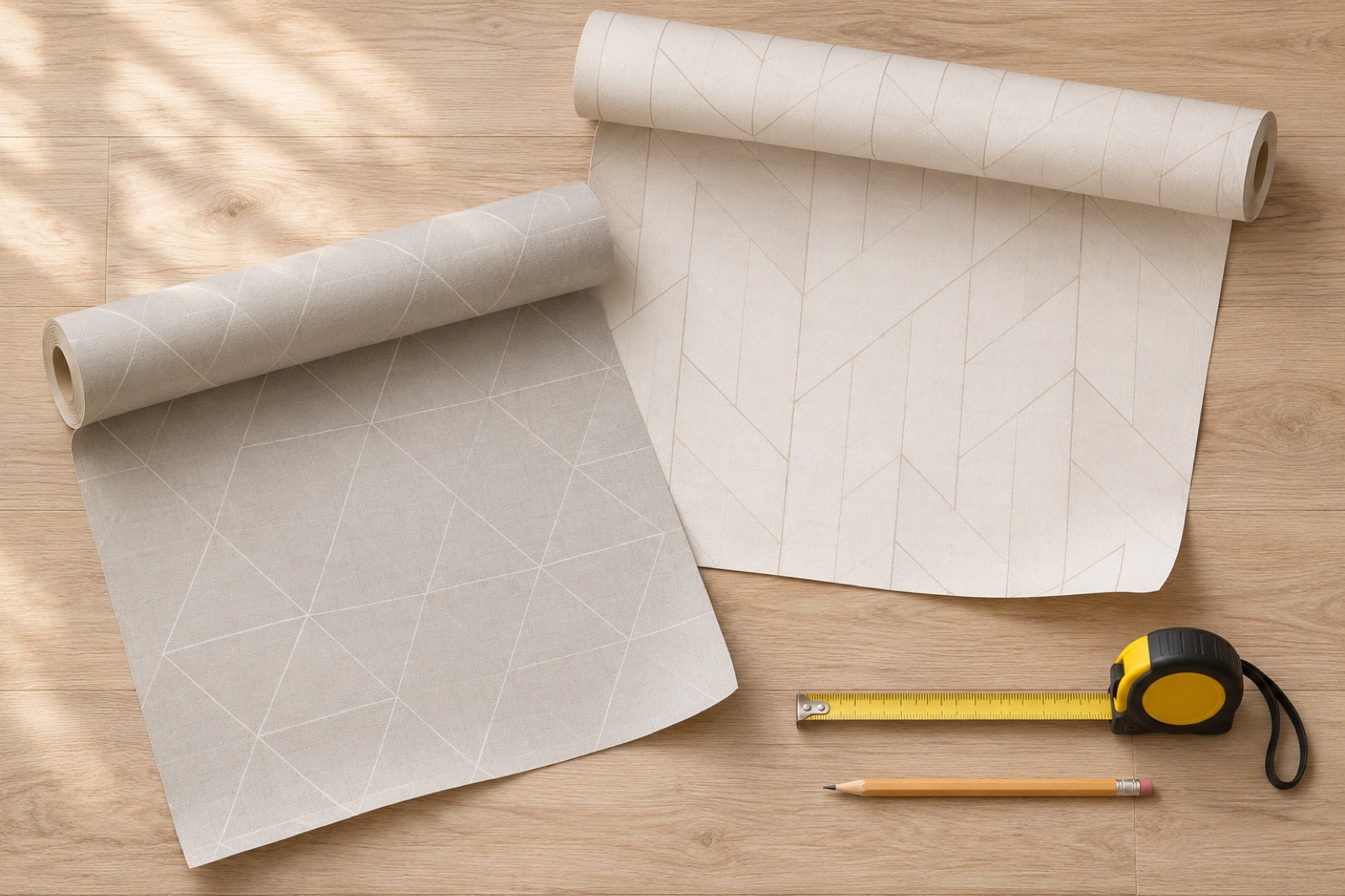
Short answer: how many rolls for 4 walls?
For a 12 x 12 ft room with 8 ft ceilings and plain paper, plan on 10 to 11 rolls of 20.5 in x 33 ft wallpaper (about 56 sq ft each). Square-foot math says 7, because it ignores that you cut whole strips, not square feet. A large pattern repeat or a half-drop match can push the count to 15.
Those are estimates under stated assumptions. The sections below show every rounding step so you can rerun the math with your own room and your own roll.
The quick answer for common rooms
All rows assume 8 ft ceilings, a roll of 20.5 in x 33 ft (396 in long, about 56.4 sq ft), 4 in of trim allowance (a 100 in cut), and no doors or windows deducted. The "24 in repeat" column is a straight match.
| Room (floor size) | Perimeter | Strips needed | Rolls, no pattern | Rolls, 24 in repeat | Rolls, counted wall by wall | Square-foot shortcut |
|---|---|---|---|---|---|---|
| 10 x 10 ft | 40 ft | 24 | 8 | 8 | 8 | 6 |
| 10 x 12 ft | 44 ft | 26 | 9 | 9 | 10 | 7 |
| 12 x 12 ft | 48 ft | 29 | 10 | 10 | 11 | 7 |
| 8 x 12 ft | 40 ft | 24 | 8 | 8 | 9 | 6 |
The square-foot column is perimeter x 8 ft divided by 56.4 sq ft, rounded up, with no waste added. It comes out one to three rolls lower than the strip method in every row. That gap is the short order.
Why there is no single number
Four things change the answer for the same room:
- Roll size. A 27 in wide roll needs fewer strips than a 20.5 in roll. A shorter roll yields fewer strips.
- Pattern repeat. The repeat length increases the cut length of every strip.
- Match type. Straight match, half-drop (offset) match and random (free) match waste different amounts.
- Openings and room shape. Doors, windows, sloped walls and alcoves change how many strips you can actually save.
What you need before you start
- A tape measure and the width and length of each wall.
- The roll width and roll length from the product page (not the "single" or "double" label alone).
- The pattern repeat in inches or centimetres, and the match type.
- The manufacturer's trim guidance. The 4 in used below is a typical figure, not a rule.
The strip method step by step
The strip method counts the vertical drops of paper the room needs, then counts how many whole drops each roll can give you. Rounding happens at every step, and the roll count only works if you round at the right moments.
Step 1: Measure the perimeter and the ceiling height
Perimeter = 2 x (length + width). Height = floor to ceiling. Do not subtract doors and windows here. Example: a 12 x 12 ft room has a 48 ft perimeter (576 in) and a 96 in height.
Step 2: Count strips = perimeter / roll width, rounded up
Example: 576 in / 20.5 in = 28.1, so 29 strips. You can never hang 0.1 of a strip, so always round up.
The perimeter method assumes paper wraps around corners. Most installers break the paper at each corner because walls are rarely plumb. For a safer count, run this step wall by wall and add the strips. The table above shows both results.
Step 3: Cut length = height + trim, rounded up to a multiple of the repeat
Cut length = height + trim allowance (typically 2 to 4 in total, so check the manufacturer's guidance). If the paper has a repeat, round that number up to the next multiple of the repeat.
Example with no repeat: 96 + 4 = 100 in. Example with a 24 in repeat: 100 / 24 = 4.17, so 5 x 24 = 120 in.
Step 4: Strips per roll = roll length / cut length, rounded down
Example: 396 / 100 = 3.96, so 3 strips per roll. With the 24 in repeat: 396 / 120 = 3.3, so still 3.
This is the step that breaks the square-foot shortcut. A roll is not a pool of square feet. The 96 in left over after three 100 in strips is almost a whole strip, but it is not one, so it cannot cover a full wall height.
Step 5: Rolls = strips / strips per roll, rounded up
Example: 29 / 3 = 9.67, so 10 rolls.
Worked example: 12 x 12 room, 8 ft ceiling, no pattern
Perimeter 48 ft, roll 20.5 in x 33 ft
The room is 12 x 12 ft with 8 ft ceilings, plain paper (or a random match) and one roll size: 20.5 in wide, 33 ft (396 in) long.
Strips needed, cut length, strips per roll, rolls
- Perimeter: 2 x (12 + 12) = 48 ft = 576 in. Height: 96 in.
- Strips: 576 / 20.5 = 28.1, rounded up to 29 strips.
- Cut length: 96 + 4 in trim = 100 in. No repeat, so no further rounding.
- Strips per roll: 396 / 100 = 3.96, rounded down to 3.
- Rolls: 29 / 3 = 9.67, rounded up to 10 rolls.
Counted wall by wall, each 12 ft wall is 144 / 20.5 = 7.02 strips, which rounds up to 8. Four walls give 32 strips, and 32 / 3 = 10.67, so 11 rolls. The 7.02 is within half an inch of 7 strips, so treat it as 8 unless your wall measures a hair under 12 ft.
This room is also on a knife edge. 396 / 100 is 3.96, so a 98 in cut (2 in trim) would fit 4 strips per roll and drop the count to 8 rolls. A roll that is a half inch short of nominal brings it back to 3. When the division lands that close, buy for the safer number.
Compare with the square-foot method and with a 10% waste add-on
Area = 48 ft x 8 ft = 384 sq ft. A roll is 20.5 x 396 / 144 = 56.4 sq ft. 384 / 56.4 = 6.8, so the shortcut says 7 rolls. Add 10% for waste: 384 x 1.1 = 422.4 sq ft, and 422.4 / 56.4 = 7.5, so 8 rolls. (If you want the area math itself, see how to calculate square feet of a wall at how to calculate square feet of a wall.)
Eight rolls give 24 strips, which is 24 x 20.5 = 492 in, or about 41 ft of paper. The perimeter is 48 ft, so you would run out about 7 ft short, most of a wall. The 10% rule of thumb exists to cover trimming and pattern loss, but here the real loss is the leftover at the end of every roll, and a flat percentage does not scale with that.
A note on units: if you buy "double rolls" and your retailer's double roll is this same 33 ft piece, then 10 of these rolls is 10 double rolls. If a retailer's single roll is half of it (16.5 ft), the same room is 20 half-length pieces, with a catch covered in the packaging section below.
Worked example: 10 x 12 room with pattern repeat
Straight match vs half-drop vs random match
- Straight match: the pattern lines up at the same height on every strip. Round the cut length up to a multiple of the repeat.
- Half-drop (offset) match: each strip is shifted by half a repeat. Plan for the multiple-of-repeat cut plus up to half a repeat of extra length.
- Random (free) match: no alignment needed. Use the no-repeat cut length.
How a repeat changes cut length and strips per roll
The 10 x 12 room has a 44 ft perimeter, which is 528 in. 528 / 20.5 = 25.76, so 26 strips in every case below. Only the cut length and strips per roll change.
| Paper | Cut length | Strips per roll | Rolls |
|---|---|---|---|
| No pattern or random match | 100 in | 396 / 100 = 3.96, so 3 | 26 / 3 = 8.67, so 9 |
| 24 in repeat, straight match | 5 x 24 = 120 in | 396 / 120 = 3.3, so 3 | 9 |
| 24 in repeat, half-drop | 120 + 12 = 132 in | 396 / 132 = 3.0, so 3 | 9 |
| 30 in repeat, half-drop | 4 x 30 + 15 = 135 in | 396 / 135 = 2.93, so 2 | 26 / 2 = 13 |
| 48 in repeat, straight match | 3 x 48 = 144 in | 396 / 144 = 2.75, so 2 | 13 |
Result side by side with the no-repeat case
A repeat does not always cost you rolls. A 24 in repeat leaves the single 33 ft roll at 3 strips, so the answer stays at 9. It only bites when the longer cut crosses a divisor of the roll length. At 135 in or 144 in, you drop from 3 strips per roll to 2, and the room goes from 9 rolls to 13.
The 24 in half-drop row deserves a warning. It divides to exactly 3.0, with no slack. One extra inch of trim or a slightly short roll costs you a strip per roll. The square-foot shortcut for this room says 7 rolls, so a shopper who trusts it ends up four to six rolls short on a large-repeat paper.
Doors, windows, sloped walls and accent walls
Why most retailers say not to deduct openings, and the one case where you can
Most wallpaper retailers advise against deducting doors and windows, and the strip method shows why. You still need the piece above a door and the pieces above and below a window, and each of those is cut from a full-length strip. On a patterned paper each piece must also match, so it eats a full repeat.
A standard 36 in door sits under one or two strips. The 16 in left above it still needs a strip cut. You free up scraps, not a whole strip.
Deducting can be reasonable in one case: plain or random-match paper and a wide opening. Take a 72 in wide window with its sill 24 in off the floor and its top at 84 in. It frames about 3 whole strips. The pieces below are 24 + 2 = 26 in and above are 12 + 2 = 14 in, so each strip position needs 40 in of paper. Three positions need 120 in, which fit inside 2 strips instead of 3 (26 + 26 + 26 + 14 = 92 in, then 14 + 14 = 28 in). You saved one strip, about a third of a roll.
In a 12 x 12 room with a 3 x 7 ft door and a 3 x 4 ft window, the square-foot shortcut with deductions says (384 - 33) / 56.4 = 6.2, so 7 rolls. That is three rolls under the strip answer, and that is how the shortcut leaves a wall unfinished.
Using the strip method to deduct whole strips only
Rule of thumb: only deduct a strip when the opening is wide enough to frame at least two full strips, the paper is plain or random-match, and the offcuts above and below add up to less than one cut length. Otherwise do not deduct. Never deduct on a pattern you need to match.
One wall or an accent wall
Use the same five steps on the single wall.
- 12 ft wide x 8 ft tall: 144 / 20.5 = 7.02, so 8 strips. 8 / 3 = 2.67, so 3 rolls. The square-foot shortcut gives 96 / 56.4 = 1.7, so 2 rolls, one fewer than you need.
- 10 ft wide x 8 ft tall: 120 / 20.5 = 5.85, so 6 strips. 6 / 3 = 2, so 2 rolls. The shortcut agrees (80 / 56.4 = 1.4, so 2).
- 10 ft wide x 10 ft tall: 6 strips. Cut length is 120 + 4 = 124 in, so 396 / 124 = 3.19, so 3 per roll, and 2 rolls. With a 24 in repeat the cut rounds up to 144 in, so 396 / 144 = 2.75, so 2 per roll, and the wall needs 3 rolls.
Sloped ceilings, alcoves and chimney breasts
For a sloped or gabled wall, use the highest point of the wall for the height. Every strip is cut as if it were that tall, then trimmed on the slope. Measuring the low point is how people end up one strip short.
Treat alcoves and chimney breasts as separate walls. Count strips for each flat face, add them up, then divide by strips per roll.
Metric version and single vs double rolls
52 cm x 10 m rolls: same method in metres
Take a 4 m x 3.5 m room, 2.4 m ceilings, and a roll of 52 cm x 10 m. Allow 10 cm of trim (about 4 in).
- Perimeter: 2 x (4 + 3.5) = 15 m = 1,500 cm. Height: 240 cm.
- Strips: 1,500 / 52 = 28.85, so 29 strips.
- Cut length: 240 + 10 = 250 cm with no pattern. With a 64 cm straight-match repeat: 250 / 64 = 3.9, so 4 x 64 = 256 cm.
- Strips per roll: no pattern 1,000 / 250 = 4. With the repeat, 1,000 / 256 = 3.9, so 3.
- Rolls: no pattern 29 / 4 = 7.25, so 8 rolls. With the repeat, 29 / 3 = 9.67, so 10 rolls.
The square-metre shortcut gives 15 x 2.4 = 36 sq m, divided by 5.2 sq m per roll, which is 6.9, so 7 rolls. It is short again, and it cannot see the repeat.
US single vs double rolls
In the US, a double roll is sold as one bolt, commonly about 20.5 in x 33 ft, and a single roll is half of that. Brands differ, so go by the width and length printed on the product page, not the label.
Packaging matters because of the rounding in step 4. A 16.5 ft piece is 198 in. With a 100 in cut it yields 1 strip, so two singles give 2 strips. One 33 ft double roll shipped as a continuous length yields 3. If a store sells both, the double roll is often the better buy for the same coverage.
Buying extra: spare roll, same batch number
A common rule of thumb is to add 10% or one spare roll, and it is cheap insurance against a mis-cut. Order everything at once and check that every roll has the same batch number on the label. Shade can differ between print runs, the same problem covered in the guide to dye lot and batch matching. Keep the spare unopened in case you have to return it.
Why stores that sell wallpaper need strip-aware quantities
Where price-per-variant and quote forms break
Merchants usually start with one of two workarounds. One is a variant per quantity ("1 roll", "2 rolls", "3 rolls"). The other is a quote form where the shopper sends room dimensions and waits for a reply.
Both leave the math to the wrong person. With variants, the shopper does the square-foot shortcut in their head, picks 7 rolls for a 12 x 12 room, and finds out at the fourth wall that they needed 10. With a quote form, someone on your team does the strip math by hand and the order is delayed. The common results are short orders, reorders from a different batch, returns and support tickets.
Whole-roll rounding, waste and repeat in a calculator, with the measurements kept in the cart
A calculator on the product page fixes this by having the shopper enter the wall size and receive a whole-roll quantity. A good setup rounds to whole rolls, applies the waste you configure, and keeps the measurements with the cart line so the shopper (and you) can see how the number was reached. If the shopper changes the quantity, the coverage shown updates with it. The Shopify wallpaper calculator page shows how that looks for a store.
What Shoperize Price Calculator does and does not do
Shoperize Price Calculator turns a shopper's area, dimensions, length, volume or weight into a purchasable Shopify quantity. You configure unit conversion, waste, package coverage, rounding, limits and product assignments, and rules can be built manually, from templates or as editable AI drafts (plan limits apply).
For wallpaper, that means you set what one roll realistically covers and how much waste to add. The app works from the coverage and waste you configure. It does not cut strips or read pattern repeats on its own, so test your settings against your own roll specs with the strip method.
For example, on 8 ft ceilings a 33 ft roll yields 3 strips of 20.5 in x 96 in of wall, which is about 41 sq ft of usable wall, not 56.4 sq ft. Entering about 41 sq ft as the package coverage gives 384 / 41 = 9.4, so 10 rolls for the 12 x 12 room, and 8, 9 and 8 for the 10 x 10, 10 x 12 and 8 x 12 rooms, matching the strip results above. A different ceiling height or repeat changes the yield, so check a few real rooms before you publish.
Shopify catalog prices decide what the shopper is charged. The calculator sets the quantity, and the price is your catalog price for that product. For the next step on measured products, see how to sell by square foot on Shopify and the square footage calculator for Shopify guide on rounding to whole packages and cart quantities. Free supports one published area calculator on up to three products, and advanced capabilities depend on the plan.
Common mistakes that cause short orders
- Subtracting windows on a patterned paper. The pieces above and below still need matched cuts, so the saving is usually zero.
- Using square footage alone. It treats the leftover at the end of each roll as usable. In the 12 x 12 example it undercounts by three rolls.
- Ignoring repeat and match type. A half-drop adds up to half a repeat to every cut and can turn 3 strips per roll into 2.
- Forgetting the second batch. Buying a spare roll later often means a different batch number. Order the spare with the rest.
- Measuring the lowest point of a sloped wall. Use the highest point, because every strip must reach it.
- Rounding strips per roll up. It must round down. A 3.96 is 3, not 4.
Frequently Asked Questions
How many wallpapers can cover a single room?
It depends on room size and roll size, so there is no single number. With 8 ft ceilings and 20.5 in x 33 ft rolls, an estimate is about 8 rolls for a 10 x 10 room, 9 for 10 x 12 and 10 for 12 x 12. See the table at the top for the assumptions.
How much wallpaper for a 12x12 room?
Plan on about 10 to 11 rolls of 20.5 in x 33 ft paper with 8 ft ceilings (29 strips, 3 per roll). That is an estimate. Square-foot math gives 7 and undercounts, and a large repeat or half-drop can raise it to 15. The worked 12 x 12 example shows each rounding step.
How many rolls for a 10x12 room?
About 9 rolls with 8 ft ceilings and the same 20.5 in x 33 ft roll, or 10 if you count wall by wall. That comes from 26 strips at 3 strips per roll. A 30 in half-drop repeat drops it to 2 strips per roll and raises the estimate to 13.
How many rolls for 1 wall?
A 12 ft wide, 8 ft tall wall needs about 3 rolls (8 strips, 3 per roll), and a 10 x 8 ft wall needs about 2. A 10 ft wide, 10 ft tall wall needs 2 rolls plain or 3 with a 24 in repeat. These are estimates, not guarantees.
Is there a wallpaper calculator with repeat?
Yes, many wallpaper retailers offer one, and you can also do it by hand with the strip method: round the cut length up to a multiple of the repeat, divide the roll length by it and round down, then divide the strips by that number. For stores, Shoperize Price Calculator works from the package coverage and waste you configure, so test it against your own roll specs.