How Many Boxes of Flooring Do I Need for 200 Square Feet?
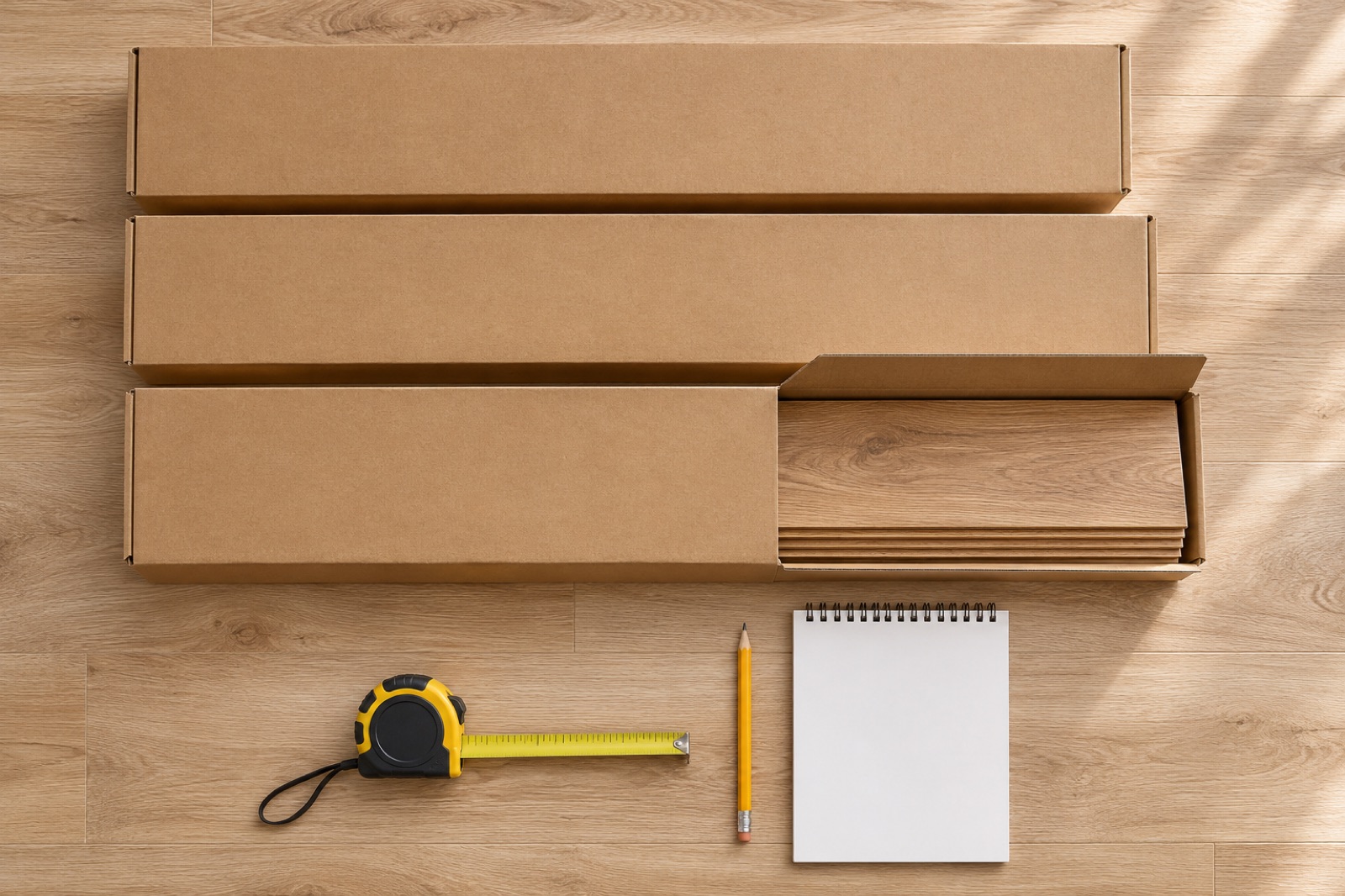
Short answer: how many boxes of flooring for 200 square feet?
For 200 square feet with 10% waste, you need 220 sq ft of flooring. That is 11 boxes of 20 sq ft, 10 boxes of 23.4 sq ft, or 9 boxes of 26 sq ft. Always round up to whole boxes, and use the coverage printed on the carton label, not a generic figure.
| Box coverage | 200 sq ft + 10% waste | Boxes needed | Sq ft you receive |
|---|---|---|---|
| 20 sq ft | 220 sq ft / 20 = 11.00 | 11 | 220 |
| 23.4 sq ft | 220 sq ft / 23.4 = 9.40 | 10 | 234 |
| 26 sq ft | 220 sq ft / 26 = 8.46 | 9 | 234 |
Different room size? Use the flooring box calculator to test other areas, waste percentages and box coverages. The rest of this guide shows the math behind the table, what happens at 5% and 15% waste, and how stores can make sure shoppers actually buy whole boxes.
The formula (3 steps)
The formula is: boxes = round up (area x (1 + waste) / sq ft per box). Three steps get you there.
Step 1: Confirm the 200 sq ft area
Your 200 sq ft might be one 10 x 20 ft room, or several spaces added together. Measure each room, multiply length by width, and add the totals.
- Rectangle: length x width. A 10 x 20 ft room is 200 sq ft.
- L-shape or irregular room: split it into rectangles, calculate each, and add. A 12 x 10 ft section plus an 8 x 10 ft section is 120 + 80 = 200 sq ft.
- Closets and alcoves: include them if the flooring goes in them. Only subtract an area if it will not be floored. Do not subtract doorways or small gaps, because those are covered by your waste allowance.
If you have a smaller room to check, the same method is worked through in how many boxes of flooring for a 12x12 room.
Step 2: Add waste
Multiply the area by 1 plus your waste percentage. At 10%, that is 200 x 1.10 = 220 sq ft. At 5% it is 210 sq ft, and at 15% it is 230 sq ft. The next section covers how to pick the percentage.
Step 3: Divide by box coverage and round up
Divide the adjusted area by the coverage per box, then round up to the next whole box. Flooring is sold in sealed cartons, so 9.40 boxes means 10 boxes. Rounding down leaves you with a short floor and a reorder that may come from a different production batch.
Worked table: 200 sq ft by box size and waste percentage
Here is every combination of three common box sizes and three waste levels. "Extra sq ft" is what you receive beyond the 200 sq ft of floor, and "effective waste" is that extra divided by 200.
5%, 10% and 15% waste for 20, 23.4 and 26 sq ft boxes
| Waste | Target area | Box size | Exact boxes | Order | Sq ft received | Extra sq ft | Effective waste |
|---|---|---|---|---|---|---|---|
| 5% | 210 sq ft | 20 | 10.50 | 11 | 220.0 | 20.0 | 10.0% |
| 5% | 210 sq ft | 23.4 | 8.97 | 9 | 210.6 | 10.6 | 5.3% |
| 5% | 210 sq ft | 26 | 8.08 | 9 | 234.0 | 34.0 | 17.0% |
| 10% | 220 sq ft | 20 | 11.00 | 11 | 220.0 | 20.0 | 10.0% |
| 10% | 220 sq ft | 23.4 | 9.40 | 10 | 234.0 | 34.0 | 17.0% |
| 10% | 220 sq ft | 26 | 8.46 | 9 | 234.0 | 34.0 | 17.0% |
| 15% | 230 sq ft | 20 | 11.50 | 12 | 240.0 | 40.0 | 20.0% |
| 15% | 230 sq ft | 23.4 | 9.83 | 10 | 234.0 | 34.0 | 17.0% |
| 15% | 230 sq ft | 26 | 8.85 | 9 | 234.0 | 34.0 | 17.0% |
What you actually end up with: leftover sq ft and effective waste
Box size changes your real waste as much as your waste percentage does. With 26 sq ft boxes, every scenario from 5% to 15% lands on 9 boxes and 234 sq ft, so your effective waste is 17% no matter which percentage you planned for. With 20 sq ft boxes, the same range jumps from 11 to 12 boxes.
That extra square footage is not wasted if you keep it. Leftover planks are your repair stock, and a sealed spare box is far easier to use than hunting for a matching one in three years.
When rounding up changes the answer
Two rows in the table are worth a closer look:
- 5% waste on 26 sq ft boxes: 210 / 26 = 8.08. Eight boxes cover 208 sq ft, which is less than the 210 you planned for and barely more than the room itself. You need 9 boxes, so a small 5% allowance turns into 17% extra material.
- 5% waste on 23.4 sq ft boxes: 210 / 23.4 = 8.97, so 9 boxes at 210.6 sq ft clears your target by only 0.6 sq ft. That is technically enough, but it leaves almost no cushion for a bad cut or a damaged plank. Many installers would add a tenth box on a room with doorways or odd corners.
How much waste should you add?
Common guidance from flooring retailers and home-improvement publishers is about 5 to 10% for a straight lay in a simple room, and around 15% for diagonal or herringbone layouts. Treat those as general ranges, not rules. Your installer and the manufacturer's installation instructions take priority.
Straight lay vs diagonal or herringbone
A straight lay lets you reuse offcuts from the end of one row to start the next, so waste stays low. Diagonal and herringbone patterns require angled cuts at every wall, and many offcuts cannot be reused. For 200 sq ft, going from 10% to 15% adds 10 sq ft to the order, which is often one extra box.
Room shape, doorways and cuts
Plan on more waste if the room has several doorways, angled walls, built-in cabinets, a fireplace hearth or a stair landing. A plain 10 x 20 ft rectangle is much more forgiving than 200 sq ft spread across four small rooms and a hallway, because each room starts and ends rows with cuts.
Spare boxes and dye lot/batch matching
Flooring is produced in batches, and shade can vary slightly between them. Buy all your boxes at once and check that the lot or batch number on the cartons matches. If you want a spare for future repairs, add it to the first order instead of hoping for a match later. For the store side of this problem, see dye lot tracking on Shopify.
Material-specific notes: laminate, vinyl plank, hardwood and tile
The formula does not change between materials. What changes is how the box coverage is stated and how much waste the material tends to produce.
Laminate and vinyl plank (boxes in sq ft)
Laminate and luxury vinyl plank usually list coverage per box in square feet, and the carton label is the source of truth. Click-lock planks tend to be forgiving of offcuts in a straight lay. For product-specific examples, see the laminate flooring calculator and the vinyl flooring calculator in square feet.
If you are asking how much vinyl flooring costs for 200 sq ft, the formula is simple: total boxes x price per box. As a purely illustrative example, if a 23.4 sq ft box were priced at $50, 10 boxes would cost $500. Substitute the real price of your product, and remember that you pay for the 234 sq ft you receive, not the 200 sq ft you cover.
Hardwood (acclimation, higher waste with short boards)
Solid and engineered hardwood often needs to acclimate in the room before installation, so check the manufacturer's instructions before the delivery date. Boards with a lot of short lengths or natural variation tend to produce more waste, because installers cull pieces with defects. For hardwood, many installers plan toward the upper end of the waste range.
Tile (cartons, different sizes)
Tile is sold by the carton, and coverage per carton varies a lot with tile size. As an illustration, a carton covering 12 sq ft would need 220 / 12 = 18.33, so 19 cartons (228 sq ft) at 10% waste. Large-format tile and diagonal layouts raise waste, and tile from different lots can differ in shade or size, so buy all cartons at once.
What is the 3/4/5 rule in flooring?
It is not a quantity rule. The 3-4-5 method is a construction squaring check: measure 3 units along one wall, 4 along the adjacent wall, and the diagonal between those points should be 5 units if the corner is square. Installers use it to check that a room is square before laying the first row. It does not tell you how many boxes to buy.
Metric version: 200 sq ft in m² and wood flooring calculators
If your supplier lists packs in square metres, convert first, then run the same formula.
200 sq ft = about 18.6 m²
One square foot is about 0.0929 m², so 200 sq ft is about 18.58 m². Add 10% waste: 18.58 x 1.10 = 20.44 m².
Pack coverage in m² and rounding
Divide 20.44 m² by the pack coverage. For a 2.2 m² pack, that is 20.44 / 2.2 = 9.29, so you order 10 packs, which cover 22.0 m². That leaves about 3.4 m² beyond the room, an effective waste of roughly 18%. A pack of 2.4 m² would need 8.52, so 9 packs and 21.6 m².
Common mistakes that cause short orders and returns
Rounding to the nearest box instead of up
At 11.5 boxes, rounding to the nearest box gives 12, which is right. At 9.40 boxes, rounding to the nearest gives 9, which is 210.6 sq ft against a 220 sq ft target. Round up every time, whatever the decimal.
Using the wrong box coverage (variant/size differences)
Two colours in the same collection can have different plank widths and different coverage per box. Check the exact product you are buying, not the one you looked at last month. A 20 sq ft assumption on a 23.4 sq ft box leads to 11 boxes where 10 would do. The reverse mistake leaves you short.
Forgetting waste or ordering exactly the area
Ordering 200 sq ft exactly means you are betting that no plank will be cut wrong, chipped in transit or discarded for a defect. Even a simple room needs some allowance.
Mixing dye lots across reorders
Running out and reordering later can mean a different batch with a slightly different shade. A little extra up front is usually cheaper than a visible mismatch in the middle of a floor.
For store owners: how to make shoppers buy whole boxes
Most shoppers do the math in their head, on a phone, with a box size they have half read. If your store sells flooring, the quantity field on the product page is where those mistakes become short orders, returns and support tickets.
Why price-per-variant workarounds fail
A common workaround is to create variants like "Covers 200 sq ft" or "Covers 250 sq ft". It breaks down fast: you cannot publish a variant for every room size, shoppers pick the nearest one and under-order, and each variant has to be updated by hand when box coverage or price changes. The quantity ends up being a guess that you fix after checkout.
Why quote forms and "enter sq ft in the notes" fields fail
A text field for square footage does not change the cart. The shopper may enter 200 sq ft and leave the quantity at 1, and nothing stops them from checking out. Someone on your team then has to read the note, work out the boxes, and email the customer. That is slow, and errors in that manual step produce the same short orders you were trying to avoid.
What works: area input, waste, package coverage, rounding up, quantity enforced in the cart
The pattern that holds up has five parts:
- The shopper enters area (or room dimensions).
- The store applies a waste percentage.
- The calculation uses the product's package coverage.
- The result is rounded up to whole packages.
- The quantity in the cart matches, and stays matched if the shopper edits it.
This is the idea behind how to sell by square foot on Shopify: the shopper thinks in area, and the store sells in packages.
How Shoperize Price Calculator does it for this 200 sq ft example
Shoperize Price Calculator turns shopper area, dimensions, length, volume or weight into purchasable Shopify product quantities, coverage and estimated totals. For a flooring product with 23.4 sq ft per box, the flow looks like this:
- The shopper enters 200 sq ft.
- The rule adds 10% waste, so the target is 220 sq ft.
- Package coverage is 23.4 sq ft, so 220 / 23.4 = 9.40 boxes.
- Rounding goes up to 10 boxes, covering 234 sq ft.
- The estimated total is 10 x the catalog box price.
The shopper's measurements stay in the cart, and the coverage display updates if they change the quantity. Merchants configure unit conversion, waste, package coverage, rounding, limits and product assignments. Rules can be built manually, from templates, or as editable AI drafts, subject to plan limits. Charges come from your Shopify catalog prices, so the box price you set is the box price the customer pays.
The Free plan supports one published area calculator on up to three products, which is enough to try it on your best-selling flooring lines. Advanced capabilities depend on the plan.
If you manage the products yourself and want to check the math first, start with the flooring box calculator to confirm what a shopper should see for a given room size.
Ready to stop correcting flooring quantities by hand? Install Shoperize Price Calculator from the Shopify App Store (details at calculator.shoperize.com), and find setup help at help.shoperize.com.
Frequently Asked Questions
How much square footage does a box of flooring cover?
It depends on the product. Plank boxes commonly cover roughly 20 to 26 sq ft, but tile cartons, hardwood bundles and some laminates can be lower or higher. Always use the coverage printed on the carton label or product page for the exact item you are buying.
How do I calculate room square footage?
Multiply length by width in feet. For an L-shaped or irregular room, split it into rectangles, calculate each one, and add them. For example, 12 x 10 plus 8 x 10 is 200 sq ft. Only subtract areas that will not receive flooring.
What is the 3/4/5 rule in flooring?
It is a squaring check, not a quantity rule. Measure 3 units along one wall and 4 along the adjacent wall, and the diagonal should be 5 units if the corner is square. Installers use it to check the room before laying flooring, not to work out how many boxes to buy.
How many boxes of flooring do I need for a 12x12 room?
A 12 x 12 ft room is 144 sq ft, or 158.4 sq ft with 10% waste. That is 8 boxes of 20 sq ft, 7 boxes of 23.4 sq ft, or 7 boxes of 26 sq ft. See the full walkthrough in the guide on how many boxes of flooring for a 12x12 room.
Do I round up or down when buying flooring boxes?
Always round up. Boxes are sealed cartons, and rounding down leaves you short of your waste-adjusted area. For example, 9.40 boxes means 10 boxes. A short order can force a reorder that may come from a different dye lot or batch.