How Many Boxes of Flooring for 1000 Square Feet (2027)
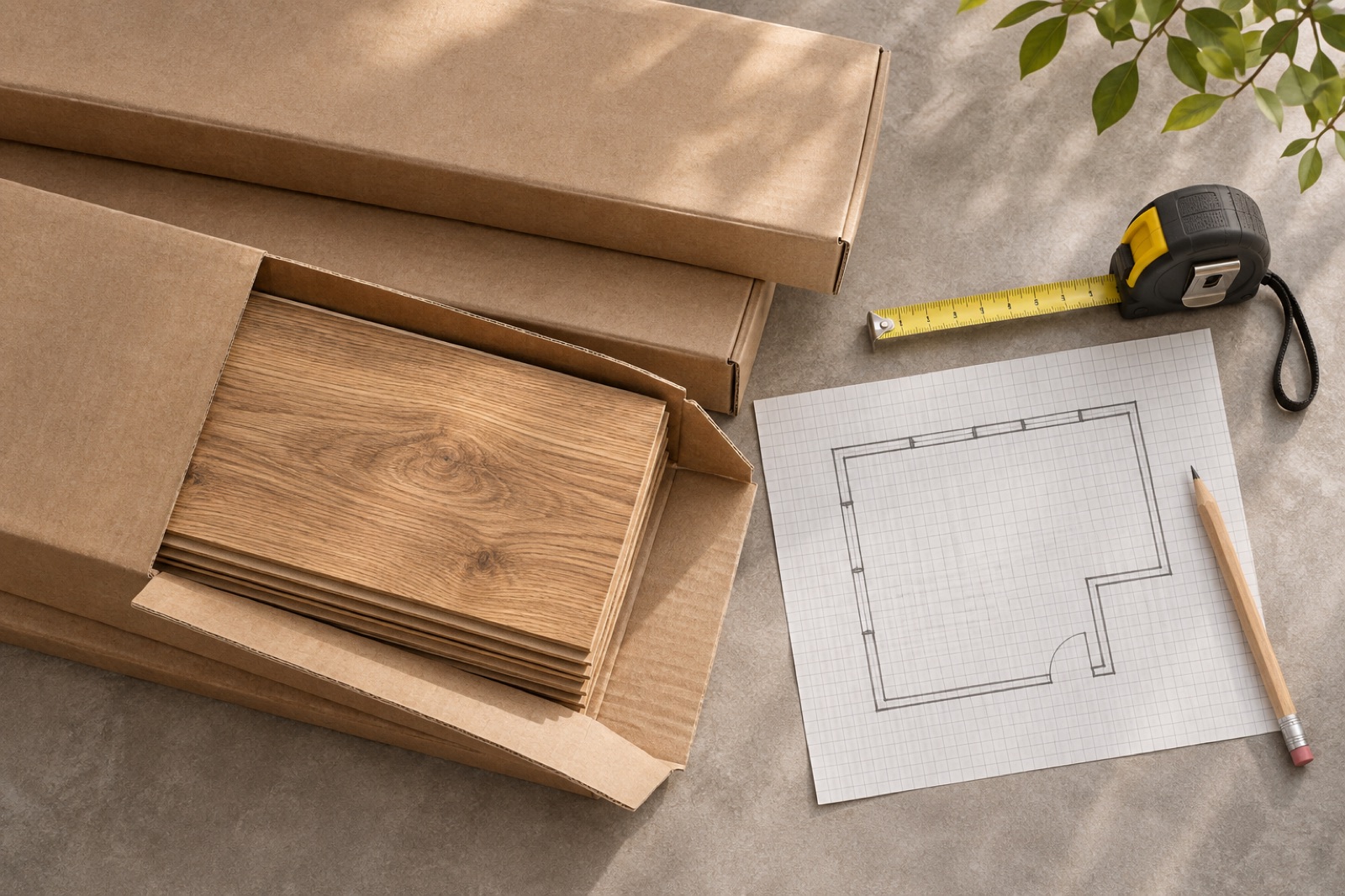
Quick answer: boxes of flooring for 1,000 square feet
For 1,000 square feet with 10% waste, you buy 1,100 square feet of flooring. That is 55 boxes of 20 sq ft, 46 boxes of 24 sq ft, or 31 boxes of 36 sq ft. For a 300 sq ft home at 10% waste, you buy 330 square feet: 17 boxes of 20, 14 of 24, or 10 of 36.
Box coverage is printed on the carton and on the product page, and it varies by product. Check yours before you use any number below, or run your own figures in the flooring box calculator.
The formula in one line
Boxes = (square feet x (1 + waste %)) / square feet per box, rounded up to a whole box.
Add waste first, divide second, round up once at the end. Everything else in this guide is that one line applied to different room sizes, waste levels and box sizes.
Answer box
A 1,000 sq ft job with 10% waste needs 1,100 sq ft of flooring. Divide by the coverage printed on your carton and round up: 55 boxes at 20 sq ft, 46 at 24 sq ft, or 31 at 36 sq ft. A 300 sq ft home needs 17, 14 or 10 boxes of those same sizes.
How to calculate how much flooring you need, step by step
You can do this on paper in five minutes. The flooring box calculator runs the same steps if you would rather not.
Step 1: Measure each room and add them up
Multiply length by width for each room, in feet. A 12 x 14 ft living room is 168 sq ft. For L-shaped rooms, split the room into rectangles and add them.
Include closets, alcoves and hallways that will get the same floor. Do not subtract cabinets or islands unless you are sure the flooring will not go under them. Subtract areas only when you are certain they will not be floored.
Add all the rooms into one total before you do anything else.
Step 2: Choose a waste percentage
Waste covers cuts, end pieces, miscuts and defects. These are common rules of thumb, so check the manufacturer's installation guidance for your product:
- 5%: simple rectangular rooms, an experienced installer, few obstacles.
- 10%: the typical figure for a straight lay.
- 15%: diagonal layouts or rooms with many cuts and angles.
- 15-20%: herringbone and other patterns with a lot of cutting.
If you are not sure, use 10%.
Step 3: Divide by coverage per box and round up
Multiply your total area by (1 + waste), then divide by the square feet per box. Any fraction means another whole box, because you cannot buy 0.5 of a carton.
Rounding at the very end matters. If you round each room separately, you tend to overbuy. If you round before adding waste, you tend to come up short. The worked room example below shows the difference.
Step 4: Check the leftover and keep a spare box
Multiply your box count by coverage per box and compare it to the area you computed. The gap is your rounding slack. Keep at least one unopened box after the install: a future repair is far easier with matching flooring from the same lot.
Worked examples: 1,000 sq ft at 5%, 10% and 15% waste
Here is the full table for a whole-house job. "Slack" is how many square feet you hold over the waste-adjusted area, which is extra protection beyond the percentage you chose.
Table: 1,000 sq ft x 3 box sizes x 3 waste levels
| Waste | Sq ft to buy | 20 sq ft boxes | 24 sq ft boxes | 36 sq ft boxes |
|---|---|---|---|---|
| 5% | 1,050 | 52.5 → 53 (1,060 sq ft, slack 10) | 43.75 → 44 (1,056, slack 6) | 29.17 → 30 (1,080, slack 30) |
| 10% | 1,100 | 55.0 → 55 (1,100, slack 0) | 45.83 → 46 (1,104, slack 4) | 30.56 → 31 (1,116, slack 16) |
| 15% | 1,150 | 57.5 → 58 (1,160, slack 10) | 47.92 → 48 (1,152, slack 2) | 31.94 → 32 (1,152, slack 2) |
Reading the table: where the rounding helps or hurts
- 20 sq ft boxes at 10% land exactly on 55 boxes. There is zero rounding slack, so your only cushion is the 10% itself.
- 20 sq ft boxes at 5% give you only 10 sq ft over the 1,050 target. One badly cut plank in a 1,000 sq ft job can use that up.
- Larger boxes carry more leftover per box. At 10%, the 36 sq ft box leaves 16 sq ft of slack against 0 for the 20 sq ft box. That is helpful protection, but also more material you paid for and may not use.
- At 15%, the 24 and 36 sq ft boxes both end up at 1,152 sq ft, with only 2 sq ft of slack. Extra percentage does not always mean extra cushion once rounding is applied.
What the no-waste number would have been
With zero waste, 1,000 sq ft is exactly 50 boxes of 20 sq ft, 42 boxes of 24 sq ft (41.67 rounded up), or 28 boxes of 36 sq ft (27.78 rounded up). Those counts leave almost nothing for cuts. At 10% waste you add 5, 4 and 3 boxes respectively.
Worked examples: 300 sq ft home at 5%, 10% and 15% waste
The same method applies to a small house or apartment. If you searched for how many boxes of flooring for a 300 sq ft home, find your box size in this table.
Table: 300 sq ft x 3 box sizes x 3 waste levels
| Waste | Sq ft to buy | 20 sq ft boxes | 24 sq ft boxes | 36 sq ft boxes |
|---|---|---|---|---|
| 5% | 315 | 15.75 → 16 (320 sq ft, slack 5) | 13.125 → 14 (336, slack 21) | 8.75 → 9 (324, slack 9) |
| 10% | 330 | 16.5 → 17 (340, slack 10) | 13.75 → 14 (336, slack 6) | 9.17 → 10 (360, slack 30) |
| 15% | 345 | 17.25 → 18 (360, slack 15) | 14.375 → 15 (360, slack 15) | 9.58 → 10 (360, slack 15) |
The no-waste baseline is 15 boxes of 20 sq ft, 13 of 24 sq ft (12.5 rounded up) and 9 of 36 sq ft (8.33 rounded up).
With 24 sq ft boxes, 5% and 10% both come out to 14 boxes, so rounding already gives the 5% order a built-in cushion. With 36 sq ft boxes, 9.17 boxes forces you to 10, which is why the 10% and 15% rows are identical.
Example: three rooms adding up to 300 sq ft
Say a small home has a 12 x 14 ft living room, a 10 x 12 ft bedroom and a 6 x 2 ft hallway. The areas are 168 + 120 + 12 = 300 sq ft. Use 20 sq ft boxes and 10% waste.
Combined ordering: 300 x 1.10 = 330 sq ft, divided by 20 = 16.5, rounded up to 17 boxes.
Per-room ordering:
| Room | Area | With 10% waste | Boxes of 20 sq ft |
|---|---|---|---|
| Living room | 168 | 184.8 | 9.24 → 10 |
| Bedroom | 120 | 132 | 6.6 → 7 |
| Hallway | 12 | 13.2 | 0.66 → 1 |
| Total | 300 | 330 | 18 |
Rounding each room separately costs one extra box, 20 sq ft you probably will not use. The cuts at the end of one room can often be reused in the next, which is the reason to pool the waste. If your installer works room by room and cannot reuse offcuts, ask them how much to add before you decide.
Scaling up: 1,500 sq ft and other sizes
At 10% waste, 1,500 sq ft becomes 1,650 sq ft to buy: 83 boxes of 20 sq ft (82.5 rounded up) or 69 boxes of 24 sq ft (68.75 rounded up). For a single room, see how many boxes of flooring for a 12x12 room.
Quick reference table for 300, 500, 1,000, 1,500, 2,000 sq ft at 10%
| Area | Sq ft to buy | 20 sq ft boxes | 24 sq ft boxes | 36 sq ft boxes |
|---|---|---|---|---|
| 300 | 330 | 16.5 → 17 | 13.75 → 14 | 9.17 → 10 |
| 500 | 550 | 27.5 → 28 | 22.92 → 23 | 15.28 → 16 |
| 1,000 | 1,100 | 55 | 45.83 → 46 | 30.56 → 31 |
| 1,500 | 1,650 | 82.5 → 83 | 68.75 → 69 | 45.83 → 46 |
| 2,000 | 2,200 | 110 | 91.67 → 92 | 61.11 → 62 |
Metric / Canada: converting square metres
Many Canadian and European cartons list coverage in square metres. One square metre is about 10.764 square feet, so divide square feet by 10.764 to get square metres. Pick one unit for the whole calculation and stick with it.
For 1,000 sq ft: 1,000 / 10.764 = about 92.9 sq m. At 10% waste that is about 102.2 sq m. If a carton covers 2.0 sq m (about 21.5 sq ft), divide 102.2 by 2.0 to get 51.1, which rounds up to 52 boxes. If you are searching for a flooring cost estimator for Canada, the same rule applies: convert once, add waste, divide, round up, then multiply by the price per square metre.
What does 1,000 sq ft of flooring cost?
You pay for whole boxes, not for the area you measured. That is the part most quick estimates leave out.
Material cost = boxes x coverage x price per sq ft
Use the area you actually buy (boxes x coverage per box), then multiply by the price per square foot on the product page. Installation, underlayment, trim, transitions, adhesive and removal of old flooring are separate line items.
Illustrative example, not a quote
Suppose a hypothetical plank is priced at $3.00 per sq ft. At 10% waste with 20 sq ft boxes:
- 55 boxes x 20 sq ft = 1,100 sq ft purchased
- 1,100 x $3.00 = $3,300
That is $300 more than 1,000 x $3.00 = $3,000, because you pay for the waste allowance. Replace $3.00 with your own price. Prices vary widely between vinyl plank, laminate, engineered and solid hardwood, so use the number from your product page rather than an average.
If you are asking how much it costs to install vinyl flooring for 1,000 sq ft, the material number above is only part of it. Labor rates depend on your area, subfloor condition and layout, so get written quotes from installers. For LVP specifically, see our vinyl flooring calculator square feet guide.
Mistakes that leave you short (or overbought)
Rounding before adding waste
If you round 1,000 sq ft of 24 sq ft boxes to 42 boxes (41.67 rounded up) and then add 10%, you get 46.2 and may round again to 47. If you add waste first you get 45.83, which is 46. Do the math in one pass: area, add waste, divide, round up once.
Mixing lots or batches
Planks from different production lots can differ slightly in color or gloss. Buy all your boxes in one order and compare the lot or batch number printed on each carton. Our flooring dye lot guide explains why a reorder weeks later is a risk on a big job.
Measuring around furniture, forgetting closets, stairs and hallways
Measure the full floor, not just the visible floor. Closets, pantries, entries and hallways add up quickly in a 1,000 sq ft total. Stairs have their own treads and risers, so measure them separately, and check the manufacturer's guidance for stair parts.
Ignoring layout and pattern
Diagonal, herringbone and staggered layouts create more offcuts. If your installer suggests a higher waste figure for the layout, use it. Also follow the manufacturer's acclimation instructions before installing.
Carpet is different: roll width and seams
Carpet is not sold in boxes. It comes on rolls, commonly 12 ft wide, though you should check the roll width for your product. You plan seams and roll length rather than box counts. Measure the longest length and the widest width of each room, then ask your supplier or installer to lay out the seams.
If you sell flooring online: don't make shoppers do this math
Everything above is what your customers are doing on their phone before they check out. Some do it correctly. Many do not.
Why per-box variants and quote forms cause wrong orders
A store that lists flooring by the box expects shoppers to measure, add waste, divide and round up on their own. Common failures include forgetting waste, rounding down, and entering square feet in the quantity field, which sells them 1,000 boxes instead of 50. The outcomes are short shipments, reorders that arrive from a different lot, returns and support tickets.
Quote forms avoid some errors but add a delay and manual work for your team. Price-per-variant workarounds, where you create a variant for each room size, tend to go out of date and still do not enforce whole boxes.
What a package-rounding calculator does
Shoperize Price Calculator turns a shopper's area, dimensions, length, volume or weight into purchasable Shopify product quantities, coverage and an estimated total. As the merchant, you set unit conversion, waste, package coverage, rounding and limits, and assign the rules to products. The shopper's measurements stay in the cart, and coverage updates if they change the quantity. Shopify catalog prices determine the charge.
If your store sells by the box, this is the Shopify flooring calculator idea: room size in, whole boxes out. The Free plan supports one published area calculator on up to three products, and advanced capabilities depend on the plan.
Example: 12 x 14 ft room, 10% waste, 20 sq ft boxes
- The shopper enters 12 ft by 14 ft: 168 sq ft.
- The rule adds 10% waste: 184.8 sq ft.
- Divide by 20 sq ft per box: 9.24.
- Round up to whole boxes: 10 boxes, covering 200 sq ft.
- The cart shows 10 boxes along with the measurements, and the total comes from your Shopify product price.
The shopper sees the number, the coverage and the total before they pay, and you receive an order that matches the room.
Ready to try it on your own products? Install Shoperize Price Calculator from the Shopify App Store (details at calculator.shoperize.com), and find setup help at help.shoperize.com.
Frequently Asked Questions
How much square footage does a box of flooring cover?
It depends on the product, so read the carton or the product page. Common sizes are around 20 to 36 sq ft per box, but some brands fall outside that range. Always use the coverage printed for your exact flooring.
How many boxes of flooring do I need for a 12x12 room?
A 12 x 12 ft room is 144 sq ft. With 10% waste you need 158.4 sq ft, which is 8 boxes of 20 sq ft (7.92 rounded up) or 7 boxes of 24 sq ft (6.6 rounded up). See our guide on how many boxes of flooring for a 12x12 room for more.
How many boxes for 1,500 square feet?
At 10% waste you need 1,650 sq ft. That is 83 boxes of 20 sq ft (82.5 rounded up), 69 boxes of 24 sq ft (68.75 rounded up), or 46 boxes of 36 sq ft (45.83 rounded up).
How do I measure a room for carpet?
Measure the longest length and the widest width of each room, then check the roll width of the carpet you want, commonly 12 ft. Carpet is planned by roll length and seam placement rather than boxes, so ask your supplier or installer to confirm the layout.
How much extra flooring should I buy?
Ten percent is the typical rule of thumb for a straight lay. Some installers use 5% for simple rooms, and 15% or more for diagonal layouts. Herringbone often calls for 15 to 20%. Check the manufacturer's guidance and round up to whole boxes.