How Many Sq Ft Does One Box of Vinyl Flooring Cover? (2027)
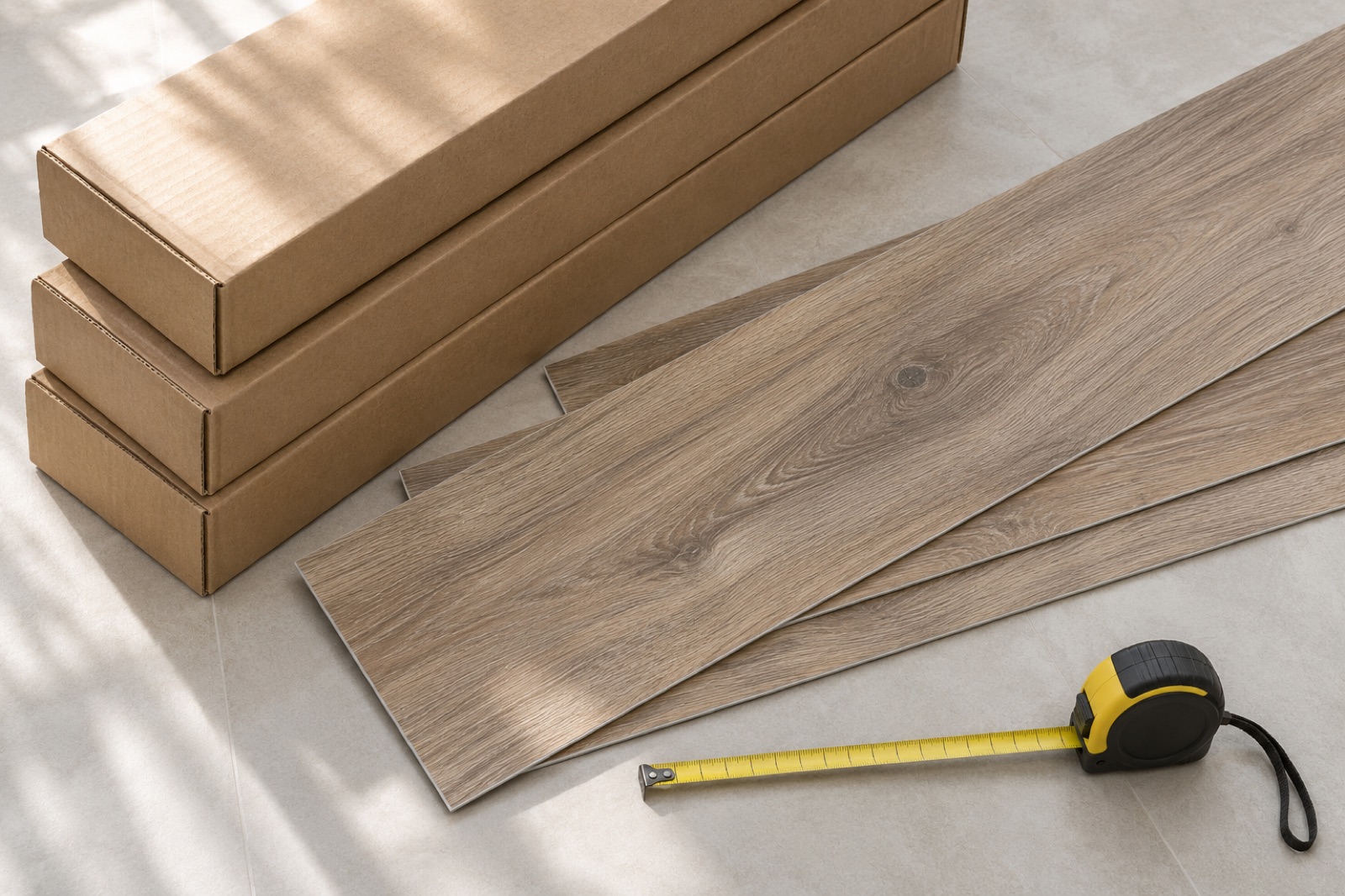
How many square feet does one box of vinyl flooring cover?
The short answer
There is no universal number. Most vinyl plank (LVP) cartons cover roughly 15 to 40 sq ft, and many land around 20 to 25 sq ft. The only figure that counts is the net coverage printed on the carton or spec sheet of the exact product you are buying. Treat the range as a typical spread, not a standard.
LVP means luxury vinyl plank. Listings also say vinyl plank, LVT (luxury vinyl tile), rigid core or SPC (stone plastic composite). The answer is the same for all of them: read the coverage for that specific product.
Why the range is wide
Coverage per box depends on a few things the manufacturer decides:
- Plank size. A 6 in x 36 in plank is 1.5 sq ft. A 9 in x 60 in plank is 3.75 sq ft.
- Planks per box. Common cartons hold anywhere from about 6 to 30 pieces.
- Thickness and core. Thicker rigid-core planks are heavier, so cartons often hold fewer pieces to keep weight manageable.
- Format. Click-lock plank, glue-down plank, LVT tile and sheet vinyl are packaged differently. Sheet vinyl is usually sold by the linear foot or roll width, not by the box.
Laminate cartons often look similar, but check them separately. We cover that in our guide to laminate flooring boxes, waste and cost.
Where to find the coverage per box
On the carton and product spec sheet
Look for "covers" or "coverage" on the carton end label, usually in sq ft and often in sq m as well. The manufacturer's spec sheet lists the same figure along with planks per carton, plank dimensions and pieces per pallet. If the carton and a website disagree, trust the carton from the batch you are actually buying.
On the product page or supplier catalog
Retail product pages normally show "sq ft per box" in the specifications. Supplier price lists and CSV catalogs often carry it as a column too. Make sure it is net coverage (what the planks cover once installed), not a gross or pallet figure.
Check it yourself: planks per box x plank area
A quick sanity check catches typos in listings:
- Plank area in sq in: 7 x 48 = 336 sq in.
- Convert to sq ft: 336 / 144 = 2.333 sq ft.
- Multiply by planks per box: 10 x 2.333 = 23.33 sq ft.
Some listings round this to 23.3 or write 23.31. A difference that small does not matter. A listing that says 20 sq ft for the same planks does, and you should ask why.
If coverage is listed in sq m
Many non-US listings give square meters. Multiply by 10.764 to get square feet. A box that covers 2.16 sq m covers about 23.25 sq ft (2.16 x 10.764). To go the other way, divide square feet by 10.764.
Do not assume 20 sq ft because it is a round number. It is a common example in calculators, not a rule about vinyl.
The formula: from room size to boxes
Area x (1 + waste) / coverage per box, rounded up
- Measure each room's length and width in feet and multiply to get sq ft.
- Add the rooms together.
- Multiply the total by (1 + waste). For 10% waste, multiply by 1.10.
- Divide by the net coverage per box.
- Round up to the next whole box.
Round once, at the end, after combining rooms. Rounding each room separately usually buys an extra box or two you did not need. For a version that does the arithmetic for you, see our vinyl flooring calculator for square feet, boxes and waste.
Waste allowance
For straight lay vinyl plank, 5 to 10% is the typical allowance, and 10% is a safe default for rooms with many cuts, doorways or closets. Diagonal and herringbone layouts need more, often 10 to 15% or higher. Always follow the manufacturer's installation guidance for the product, since it overrides any rule of thumb.
Worked examples: boxes for common sizes
The table uses 10% waste and three example box sizes: 20 sq ft, 23.3 sq ft (ten 7 x 48 in planks) and 36 sq ft. Each cell shows boxes, then the total sq ft you would buy in brackets.
| Room area | Need with 10% waste | 20 sq ft box | 23.3 sq ft box | 36 sq ft box |
|---|---|---|---|---|
| 144 sq ft (12 x 12) | 158.4 | 8 (160) | 7 (163.1) | 5 (180) |
| 200 sq ft | 220 | 11 (220) | 10 (233) | 7 (252) |
| 400 sq ft | 440 | 22 (440) | 19 (442.7) | 13 (468) |
| 1,000 sq ft | 1,100 | 55 (1,100) | 48 (1,118.4) | 31 (1,116) |
| 1,500 sq ft | 1,650 | 83 (1,660) | 71 (1,654.3) | 46 (1,656) |
| 1,600 sq ft | 1,760 | 88 (1,760) | 76 (1,770.8) | 49 (1,764) |
Notice that box size changes both the count and the leftover. At 144 sq ft, the 36 sq ft box leaves you with 180 sq ft, which is 21.6 sq ft more than you need. The 23.3 sq ft box leaves 4.7 sq ft extra.
12 x 12 room (144 sq ft)
12 x 12 = 144 sq ft. With 10% waste that is 158.4 sq ft, so you need 8 boxes at 20 sq ft, 7 at 23.3 sq ft, or 5 at 36 sq ft. For layout, cut and underlayment detail, see how many boxes of flooring you need for a 12x12 room.
200 sq ft
200 x 1.10 = 220 sq ft. That is exactly 11 boxes at 20 sq ft, 10 boxes at 23.3 sq ft (233 sq ft) or 7 boxes at 36 sq ft (252 sq ft). The 20 sq ft case divides evenly, which is rare in practice.
400 sq ft
400 x 1.10 = 440 sq ft. That is 22 boxes at 20 sq ft, 19 at 23.3 sq ft (442.7 sq ft) or 13 at 36 sq ft (468 sq ft). The 36 sq ft option leaves 28 sq ft beyond the waste-adjusted need, which is not wasted if you keep it for repairs.
1,000 and 1,500 sq ft
1,000 sq ft becomes 1,100 sq ft: 55 boxes at 20, 48 at 23.3 or 31 at 36. 1,500 sq ft becomes 1,650 sq ft: 83 boxes at 20 (1,660 sq ft), 71 at 23.3 (1,654.3 sq ft) or 46 at 36 (1,656 sq ft). At this scale the box count matters for pallets and delivery, so confirm full pallet quantities with the supplier.
1,600 sq ft
1,600 x 1.10 = 1,760 sq ft: 88 boxes at 20, 76 at 23.3 (1,770.8 sq ft) or 49 at 36 (1,764 sq ft). If you want to run your own room sizes, use the flooring box calculator.
How much does a box of vinyl flooring cost, and what does 200 sq ft cost?
Price per sq ft x coverage = price per box
Prices vary widely by brand, thickness, wear layer and region, so check the current price of your product. The formula is simple: price per box = price per sq ft x sq ft per box.
As an illustrative example only (not market data), at $3.00 per sq ft a 23.3 sq ft box costs $3.00 x 23.3 = $69.90.
Cost of 200 sq ft and 1,600 sq ft
You pay for whole boxes, including the waste allowance, not just the floor area. Using the same illustrative $3.00 per sq ft:
- 200 sq ft: 11 boxes of 20 sq ft x ($3.00 x 20 = $60 per box) = $660 in material. With 23.3 sq ft boxes, it is 10 boxes x $69.90 = $699.
- 1,600 sq ft: 88 boxes of 20 sq ft x $60 = $5,280 in material.
Replace $3.00 with your actual price per sq ft. Installation is a separate line. For 1,600 sq ft, labor depends on your region, the installer, the product type and how much subfloor prep (leveling, removal of old flooring, moisture checks) is needed. Installers usually quote per sq ft or per job, so get two or three written quotes and ask what is included: trim, transitions, furniture moving and haul-away.
Linoleum vs vinyl: which is cheaper?
It depends on the grade. Linoleum is a natural-material floor and vinyl is a synthetic one, and both come in budget and premium versions. Compare the per-sq-ft price of the exact products you are considering, then add installation, since linoleum and sheet products can need more specialized installation than click-lock vinyl plank. The cheaper floor on paper is not always the cheaper floor installed.
For merchants: set coverage per box as package coverage
If you sell flooring online, the question above is one your customers type into search before they buy. The risk is that they guess the number and order the wrong quantity. Our guide on how to sell by square foot on Shopify with box examples covers the basics. Here is the vinyl-specific version.
Why price-per-box variants and quote forms cause wrong orders
Two common workarounds both fail in predictable ways:
- Price-per-box with a plain quantity field. The shopper has to do the math themselves. They forget waste, use the wrong coverage, or assume 20 sq ft. You get short orders, reorders from a different batch, returns and support emails.
- "Enter your sq ft" quote forms. Someone on your team has to read the form, calculate boxes and fix the order by hand. It is slow, and a typo still becomes a wrong cart.
The fix is to store the coverage per box and let the cart enforce whole boxes.
Setting up: coverage per box, waste, rounding, min and max
With Shoperize Price Calculator, the shopper enters an area or room dimensions. The app applies your waste percentage, rounds up to whole packages, and shows the coverage and an estimated total. The charge comes from your Shopify catalog price, which is the price per box. You configure:
- Unit conversion (for example, sq m to sq ft).
- Waste percentage.
- Package coverage (the net sq ft per box).
- Rounding to whole boxes.
- Minimum and maximum limits.
- Which products the rule applies to.
Worked example: a shopper enters a 12 x 14 ft room, which is 168 sq ft. With 10% waste that is 184.8 sq ft. At 23.3 sq ft per box, 184.8 / 23.3 = 7.93, so the cart gets 8 boxes covering 186.4 sq ft. Different vinyl lines have different coverage, so assign a separate rule to each product whose coverage differs.
The Free plan supports one published area calculator on up to three products. Advanced capabilities depend on the plan.
Keeping the measurement in the cart
The shopper's measurement stays in the cart, and coverage updates if they change the box quantity. If they drop from 8 boxes to 7, they can see that coverage no longer meets the room. That is the point: the shopper sees the consequence before checkout, not after the pallet arrives.
Storing coverage per variant when you have hundreds of SKUs
Coverage often differs by variant, since a color or plank size can come in a different carton. A practical approach is to keep the supplier's coverage per box in a variant metafield and treat it as your source of truth when you set up rules. For a small catalog, Shopify's native editing and bulk editor are enough, as we explain in our guide to bulk editing variant metafields in Shopify.
For hundreds of SKUs, Shoperize Variant CSV can import a supplier CSV into existing variant metafield definitions. It matches on exact unique SKU, validates typed values, and shows a before and after review you must approve before anything is applied. Blank cells leave existing values unchanged, so a half-filled supplier file will not wipe data.
Common mistakes that cause short or over-ordered vinyl
Assuming every box is 20 sq ft
Using 20 when the carton says 23.3 means you buy more than you need. Using 20 when it says 17.6 means you come up short. Always read the net coverage on the product you are buying.
Mixing different products or dye lots
Planks from different production runs can vary slightly in color and gloss. Buy all boxes in the same order, check that lot or batch numbers match, and do not mix products to fill a gap. Our flooring dye lot guide explains how to handle this in a store.
Rounding per room instead of combined area
Three rooms of 90, 110 and 130 sq ft at 23.3 sq ft per box need 4, 5 and 6 boxes if rounded separately (4 + 5 + 6 = 15 boxes after 10% waste per room: 99, 121 and 143 sq ft divide to 4.25, 5.19 and 6.14, so 5, 6 and 7 boxes, which is 18). Combined, 330 sq ft x 1.10 = 363 sq ft, which is 15.6, so 16 boxes. Round once and you save two boxes.
Forgetting spare boxes and underlayment
Keep one extra box if your product is discontinued often, so you can repair a damaged plank later. Also check whether the planks have underlayment attached. If not, underlayment is a separate purchase, usually sold by the roll with its own coverage, and the roll count follows the same formula.
Sell by the box without the guesswork
If your store sells vinyl, tile or other flooring by the box, Shoperize Price Calculator turns room measurements into whole boxes, coverage and an estimated total in the cart. You can install it from the Shopify App Store, read the details at calculator.shoperize.com, and find setup help at help.shoperize.com.
Frequently Asked Questions
Which is cheaper, linoleum or vinyl?
It depends on the grade of each product and on installation. Both come in budget and premium versions, so compare the per-sq-ft price of the exact products you are considering, then add installation quotes. Click-lock vinyl plank is often simpler to install, which can change the total.
How many boxes of flooring for 200 sq ft?
With 10% waste you need 220 sq ft of flooring. That is 11 boxes at 20 sq ft each, 10 boxes at 23.3 sq ft (233 sq ft) or 7 boxes at 36 sq ft (252 sq ft). Always use the net coverage printed on your carton.
How many boxes to cover 400 square feet?
With 10% waste you need 440 sq ft. That is 22 boxes at 20 sq ft, 19 boxes at 23.3 sq ft (442.7 sq ft) or 13 boxes at 36 sq ft (468 sq ft). Round up to whole boxes only after combining all rooms.
How much to install 1,600 sq ft of vinyl flooring?
It varies by region, installer, product type and how much subfloor prep is needed, so there is no reliable single figure. Get two or three written quotes, usually per sq ft or per job, and confirm what is included, such as trim, transitions and removal of old flooring.
Does the same answer apply to laminate?
The method is the same: area x (1 + waste) / coverage per box, rounded up. Laminate cartons often cover a similar amount, but the number varies by product, so check the carton. Laminate also commonly needs its own underlayment, so confirm what is included.